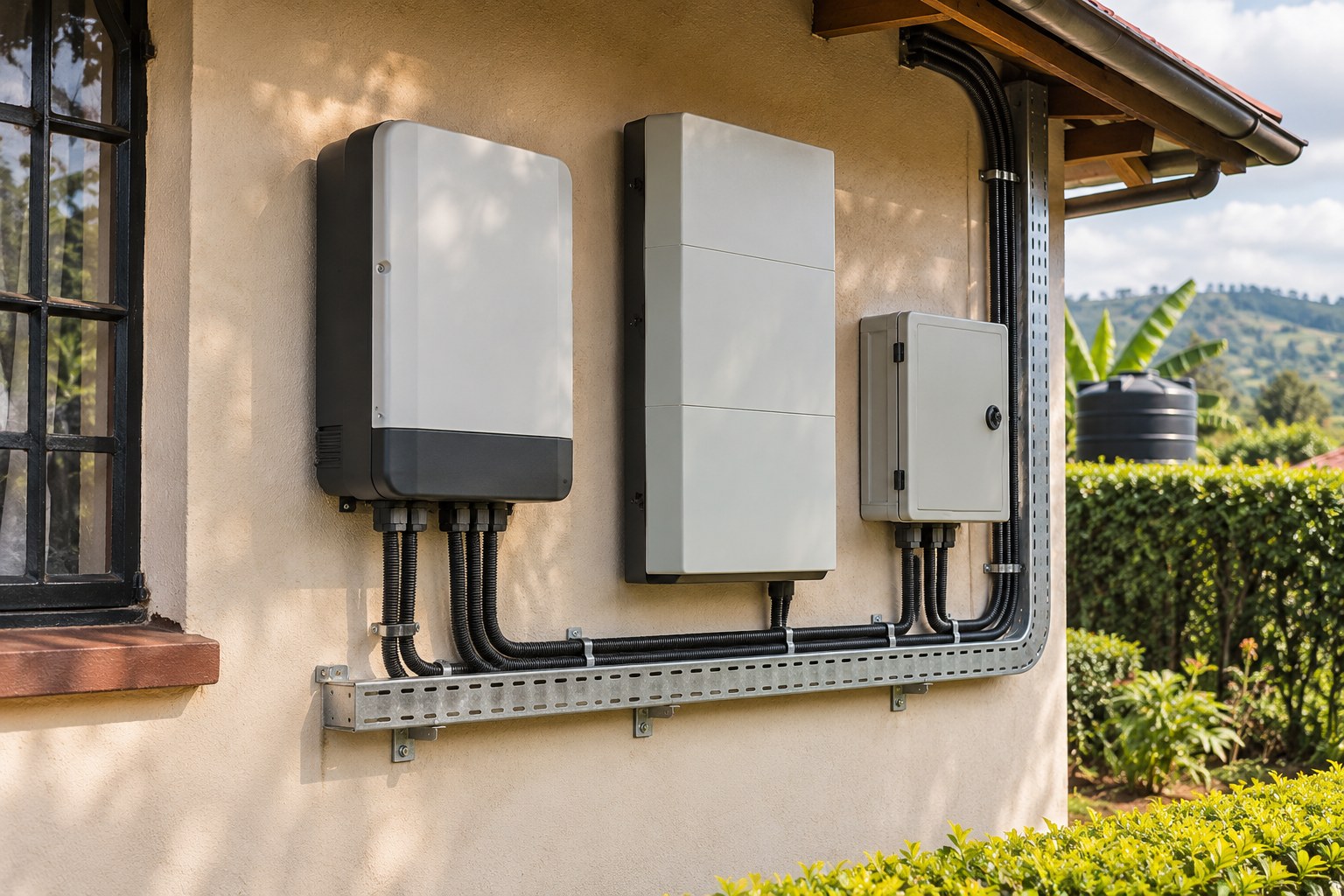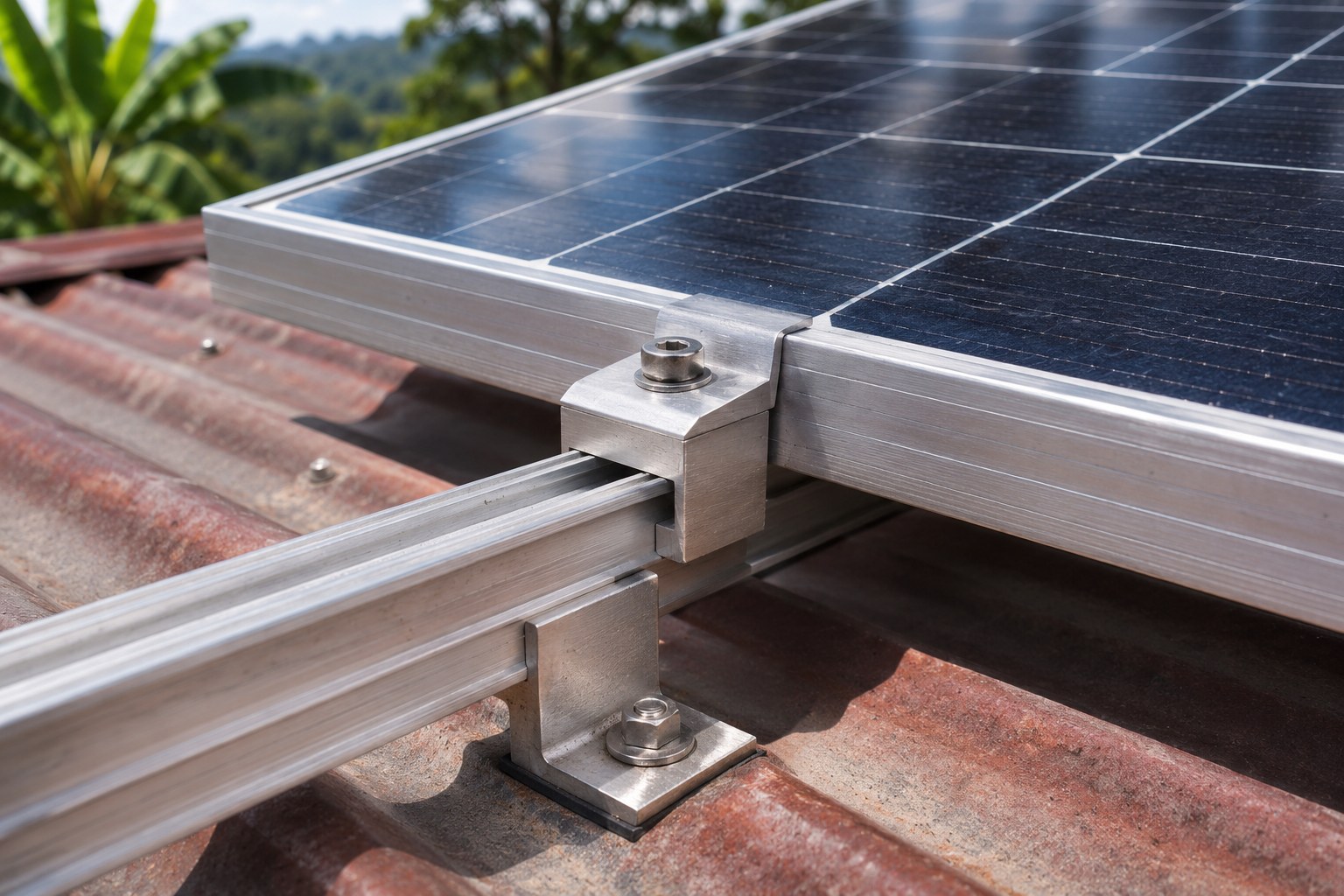
If you are assessing coastal solar mounting corrosion Kenya, start with documented material suitability for the assessed exposure. Assess exposure, compatible materials, coatings, fixings and maintenance using supplier evidence. A location label alone does not establish a corrosion category.
This decision guide was reviewed on 24 November 2026. The worked scenario is illustrative. It is not a measured customer result, an equipment recommendation or a company price offer.
Coastal solar mounting corrosion Kenya: the decision to resolve
The practical question is whether the proposed arrangement demonstrates documented material suitability for the assessed exposure. Begin with the service you need, then ask what evidence would confirm that the proposal can provide it. Avoid replacing that question with a panel count, a product label or an unexplained system-size recommendation.
| Evidence to prepare | How to make the record useful |
|---|---|
| Site exposure | Provide the actual source record and its date. Distinguish a measurement from an assumption, and identify anything that may change before installation. |
| Material specification | Use the relevant units and operating period. Include the limiting condition as well as the convenient survey-day condition. |
| Coating evidence | Supply model-specific information where equipment is involved. Keep document revisions and the party responsible for confirming the information. |
| Inspection access | State the required service and who approves it. Record unresolved questions so the quotation does not silently treat them as settled facts. |
A worked example for coastal solar mounting corrosion Kenya
A site near the sea may need a different material and maintenance assessment from a sheltered inland roof. Compare documented environmental suitability rather than relying on a generic stainless or marine-grade description.
The lesson is the role of documented material suitability for the assessed exposure, not the purchase of a particular product. Replace the scenario assumptions with your own records before making a commitment. Ask the responsible designer to show which conclusion changes when the demand, timing or site condition changes. A sound quotation should make that reasoning visible.
Assess environmental exposure rather than using a location stereotype
Coastal and other exposed sites need an assessment of the actual environment, materials and maintenance access. Salt, wind, moisture and corrosion risk can differ substantially between properties in the same region. Ask for supplier evidence and a project-specific review of the proposed materials and fixing arrangement.
In particular, compatible materials, coatings and fasteners belong in the specification. A generic phrase such as marine grade does not explain every component or warranty condition. The owner should understand the required inspection and maintenance plan as well as the initial purchase. Avoid inventing a local weather measurement or assigning an exposure category without evidence. A useful regional guide helps the buyer prepare questions for the specific site assessment.
Use measured usable roof space
Gross roof area is not the same as available array area. Obstructions, shading, rooflights, access routes and the building's condition can reduce the space that is usable. The survey should record these constraints before a panel count is promised. Actual module dimensions then need to be fitted into an approved layout.
Furthermore, the roof covering does not describe the whole supporting structure. A competent assessment must consider the proposed load path and attachment arrangement. Ask how existing defects, waterproofing and any roof warranty will be handled. The resulting drawing should preserve safe access for future service work. This is a procurement and coordination question for the owner; it is not a reason for an unqualified person to climb onto the roof or inspect live installation equipment.
Agree a fair baseline before claiming savings
A baseline describes the service and consumption against which a change will be assessed. Record the period, meter boundaries, operating activity and known unusual events before work starts. Otherwise a later bill reduction can be attributed to the wrong cause. Lower occupancy, fewer production hours or a change in tariff can alter the result independently of solar.
Therefore, agree how the comparison will handle such changes. A factory may need production data; a lodge may need occupied room-nights; a pumping project may need delivered water volume and head. Select a measure that reflects the actual service. Report missing data and uncertainty rather than filling gaps with an optimistic assumption. This makes performance review more useful to the customer and prevents an attractive headline from hiding a weak comparison.
Give organisations control of their operating information
Monitoring and project records often outlive the person who first set them up. Use an appropriate organisational account and define administrator, operator and service-provider roles. Avoid routine dependence on a private password shared informally among staff. Ask how access changes when a service contract or property ownership changes.
Where monitoring or security records contain personal information, handle access and sharing through the applicable data-protection requirements. Do not collect more information than the task needs. Also check export capability, retention and any subscription dependency before purchase. A customer should know what information remains available if connectivity fails or a supplier relationship ends. These questions are part of a durable handover rather than optional software conveniences.
Further reading: ODPC: Kenyan data-protection laws.
Compare alternatives at the same useful output
Choose a common service target before comparing options. This might be the same backed-up load and duration, the same delivered water duty, or the same hot-water demand. Equal nameplate power, tank litres or battery labels do not necessarily establish equivalent service. Include the supporting components required by each alternative.
However, avoid forcing every option into an artificial single number. An alternative may offer a different maintenance burden, operating flexibility or continuity arrangement. Describe those differences openly and decide which matter to the customer. A slightly cheaper equipment purchase can become the more expensive operating choice if it needs frequent access, unsupported controls or unavailable spares. The comparison should make the trade-off understandable instead of implying that one technology wins in every situation.
Resolve ownership and access before installation
The physical owner, electricity-account holder, occupier and maintenance decision-maker may be different people. Clarify their roles before work proceeds. A tenant, estate committee or project donor needs an agreed basis for installation access, future inspection, funding and any asset transfer. Energy savings do not automatically settle these responsibilities.
In addition, consider what happens when occupancy or management changes. Equipment records, monitoring access and warranty rights may need an authorised transfer. Avoid a service arrangement that relies solely on one person's private account. Where a lease, ownership agreement or legal obligation requires interpretation, obtain appropriate professional advice. The solar quotation should identify the relevant project responsibilities without pretending to replace the underlying property or governance documents.
Separate the electricity bill into relevant components
Use the customer's actual tariff category and bill history when estimating avoided costs. The average amount paid divided by imported kWh may combine energy charges with other items. A reduction in energy imports does not necessarily remove every charge. Demand-related charges also require attention to when the site's peak occurs.
For example, a PV array may reduce daytime purchases without eliminating an evening demand peak. Show self-consumed energy, approved exports and remaining purchases separately. Use current applicable information from the utility and regulator. Where that evidence is missing, retain a clearly labelled assumption rather than presenting it as the current Kenyan electricity price. A transparent estimate explains the relationship between the physical energy model and the financial calculation.
Further reading: EPRA electricity tariff guidance.
Make expansion a defined design scenario
Future readiness needs a named scenario. Describe the additional equipment, operating hours, location and intended service rather than asking for an unspecified percentage of spare capacity. The relevant constraint may be power, energy, roof space, electrical connection, hydraulic duty or control compatibility.
An installation can have room for more modules while lacking capacity at another interface. Therefore, ask which items support the proposed later phase and which will need reassessment, replacement or further approval. Keep that distinction in the design and quotation. This helps the customer avoid paying now for an undefined capability while also preventing a future contractor from treating an old allowance as blanket permission for any expansion.
Turn the evidence into a clear go-or-no-go decision
For coastal solar mounting corrosion Kenya, require an explanation of documented material suitability for the assessed exposure in the written proposal. A useful answer connects the project records to a stated service boundary. If essential information is missing, the next decision is to obtain the measurement or professional review that resolves it, rather than choose equipment around an optimistic guess.
- Proceed when the relevant evidence supports the proposed service and the responsible parties have closed material design questions.
- Revise the scope when the worked assumptions do not match the real site, operating pattern or equipment limits.
- Request further assessment when permissions, condition, compatibility or critical-service requirements remain unresolved.
Questions buyers ask
What should I prepare before requesting a quotation?
For this assessment, prepare site exposure, material specification, coating evidence and inspection access. Explain the required outcome and any known limitations. Send records from safe accessible sources; a qualified person should collect hazardous measurements or inspect restricted equipment.
What matters most when comparing coastal solar mounting corrosion Kenya?
Assess exposure, compatible materials, coatings, fixings and maintenance using supplier evidence. A location label alone does not establish a corrosion category. Compare the alternatives against the same defined service and ask for model-specific supporting evidence. Where proposals use different assumptions, have those differences made explicit before comparing totals.
Can I use the worked example as my final design or price?
No. The example explains a decision method and uses stated assumptions. Your site may have different operating conditions, equipment limits and scope. A final design and quotation need the relevant assessment, written inclusions and applicable approvals.
Prepare your project-specific enquiry
Review our solar panel mounting information, then request a site survey with the records listed above. For coastal solar mounting corrosion Kenya, explain the required outcome, the property location and the operating constraints. Ask for a written scope, assumptions and exclusions before you commit to equipment.
The solar calculator can help organise a preliminary energy enquiry. Treat its result as an estimate and supply actual load and site records for the final assessment.