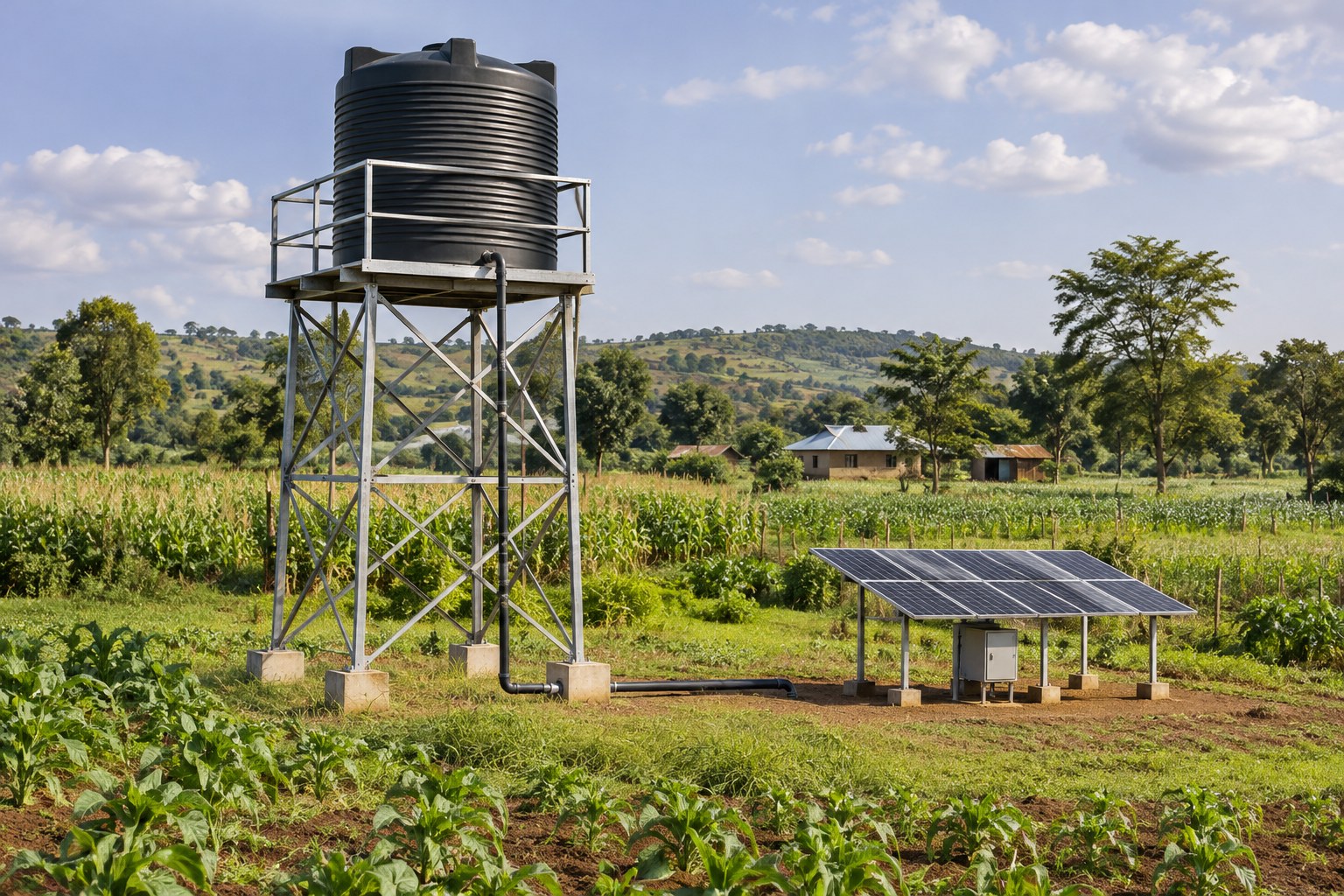
If you are assessing gravity water supply pressure Kenya, start with pressure available at the actual service point. Assess the level difference and distribution losses at the required flow. Tank height alone does not guarantee adequate pressure at every outlet.
This decision guide was reviewed on 24 November 2026. The worked scenario is illustrative. It is not a measured customer result, an equipment recommendation or a company price offer.
Gravity water supply pressure Kenya: the decision to resolve
The practical question is whether the proposed arrangement demonstrates pressure available at the actual service point. Begin with the service you need, then ask what evidence would confirm that the proposal can provide it. Avoid replacing that question with a panel count, a product label or an unexplained system-size recommendation.
| Evidence to prepare | How to make the record useful |
|---|---|
| Water surface elevation | Provide the actual source record and its date. Distinguish a measurement from an assumption, and identify anything that may change before installation. |
| Highest outlet | Use the relevant units and operating period. Include the limiting condition as well as the convenient survey-day condition. |
| Pipe losses | Supply model-specific information where equipment is involved. Keep document revisions and the party responsible for confirming the information. |
| Simultaneous demand | State the required service and who approves it. Record unresolved questions so the quotation does not silently treat them as settled facts. |
A worked example for gravity water supply pressure Kenya
Ten metres of water head is approximately 0.98 bar before pipe losses. A ten-metre elevation difference therefore does not promise one bar at a distant outlet while other users are drawing water.
The lesson is the role of pressure available at the actual service point, not the purchase of a particular product. Replace the scenario assumptions with your own records before making a commitment. Ask the responsible designer to show which conclusion changes when the demand, timing or site condition changes. A sound quotation should make that reasoning visible.
Use the operating head, not borehole depth alone
Total dynamic head accounts for the water lift to the delivery point and the relevant losses at the intended flow. In a borehole, the pumping water level matters; total drilled depth alone does not give the operating head. Delivery elevation, pipework and required outlet conditions add other parts of the duty.
Consequently, a pump selection needs a marked duty point on suitable manufacturer performance information. Maximum head and maximum flow are different ends of a performance description, not a guaranteed simultaneous output. Ask the responsible designer to explain how the source records and delivery route produce the selected duty. This is more useful than requesting a pump by horsepower and expecting the required litres to follow automatically.
Define delivered water before choosing pumping equipment
Start with the daily useful volume, the delivery points and the time when users need water. Then assess whether the source can support that demand sustainably. A pump's motor rating is not a daily delivery specification. Its flow changes with the hydraulic duty and available operating conditions.
For solar pumping, the effective operating period can vary with weather and control limits. Storage may separate pumping time from use, but it brings its own usable-volume and delivery-pressure requirements. Ask the designer to show a credible daily water balance. Where the input data are uncertain, identify the additional survey or professional interpretation needed. A larger array should not be used to justify abstraction beyond the source's tested capacity or applicable permission.
Further reading: Water Resources Authority: permitting and water-use allocation.
Check pressure and hydraulic compatibility
Pressure suitability depends on the actual supply and the permitted arrangement of every relevant component. A larger tank or a more powerful pump does not resolve an incompatible pressure rating. Ask the specialist to assess the source, booster equipment, operating levels and delivery requirements together.
In a hot-water installation, storage support, pipework, fittings and the manufacturer's safety arrangements also matter. Terms such as pressurised, non-pressurised, direct and indirect describe different aspects of a system. They should not be treated as interchangeable product tiers. Obtain the supported configuration for the building and the required service. The owner should receive approved operating and maintenance information, without being asked to adjust pressure controls or modify plumbing safety devices.
Make expansion a defined design scenario
Future readiness needs a named scenario. Describe the additional equipment, operating hours, location and intended service rather than asking for an unspecified percentage of spare capacity. The relevant constraint may be power, energy, roof space, electrical connection, hydraulic duty or control compatibility.
An installation can have room for more modules while lacking capacity at another interface. Therefore, ask which items support the proposed later phase and which will need reassessment, replacement or further approval. Keep that distinction in the design and quotation. This helps the customer avoid paying now for an undefined capability while also preventing a future contractor from treating an old allowance as blanket permission for any expansion.
Resolve ownership and access before installation
The physical owner, electricity-account holder, occupier and maintenance decision-maker may be different people. Clarify their roles before work proceeds. A tenant, estate committee or project donor needs an agreed basis for installation access, future inspection, funding and any asset transfer. Energy savings do not automatically settle these responsibilities.
In addition, consider what happens when occupancy or management changes. Equipment records, monitoring access and warranty rights may need an authorised transfer. Avoid a service arrangement that relies solely on one person's private account. Where a lease, ownership agreement or legal obligation requires interpretation, obtain appropriate professional advice. The solar quotation should identify the relevant project responsibilities without pretending to replace the underlying property or governance documents.
Use water-quality evidence for maintenance planning
Water characteristics can affect equipment suitability and service needs. Where scaling, sediment or corrosion has been a problem, supply the relevant history and any available water analysis. Have the equipment provider explain its supported operating and maintenance conditions. Do not assume that a generic low-maintenance claim applies to an unsuitable water supply.
However, a buying guide should not prescribe unapproved chemicals or customer cleaning procedures. Follow the actual manufacturer's requirements and use appropriate service personnel. Include access, inspection and any required consumables in the operating budget. Also read warranty conditions relating to water quality. This makes the expected maintenance responsibility clearer before purchase and gives future service visits a useful evidence base.
Further reading: US Department of Energy: solar water-heating systems.
Compare alternatives at the same useful output
Choose a common service target before comparing options. This might be the same backed-up load and duration, the same delivered water duty, or the same hot-water demand. Equal nameplate power, tank litres or battery labels do not necessarily establish equivalent service. Include the supporting components required by each alternative.
However, avoid forcing every option into an artificial single number. An alternative may offer a different maintenance burden, operating flexibility or continuity arrangement. Describe those differences openly and decide which matter to the customer. A slightly cheaper equipment purchase can become the more expensive operating choice if it needs frequent access, unsupported controls or unavailable spares. The comparison should make the trade-off understandable instead of implying that one technology wins in every situation.
Define an observable acceptance test
Acceptance should demonstrate the service the customer agreed to buy. Identify the test conditions, measurements, responsible witnesses and the evidence that will be retained. A dashboard showing normal status is useful, but it may not prove backup duration, delivered water, temperature continuity or a correctly functioning control sequence.
In practice, the test needs appropriate professional planning. Do not ask a customer to create unsafe faults, alter live wiring or bypass protection. Instead, have competent personnel test the agreed functions through a supported procedure. Record defects and the authority for return to service. If conditions prevent a meaningful performance test on the first visit, document the outstanding verification rather than quietly treating it as complete. A clear acceptance record protects both the buyer and the contractor.
Turn the evidence into a clear go-or-no-go decision
For gravity water supply pressure Kenya, require an explanation of pressure available at the actual service point in the written proposal. A useful answer connects the project records to a stated service boundary. If essential information is missing, the next decision is to obtain the measurement or professional review that resolves it, rather than choose equipment around an optimistic guess.
- Proceed when the relevant evidence supports the proposed service and the responsible parties have closed material design questions.
- Revise the scope when the worked assumptions do not match the real site, operating pattern or equipment limits.
- Request further assessment when permissions, condition, compatibility or critical-service requirements remain unresolved.
Questions buyers ask
What should I prepare before requesting a quotation?
For this assessment, prepare water surface elevation, highest outlet, pipe losses and simultaneous demand. Explain the required outcome and any known limitations. Send records from safe accessible sources; a qualified person should collect hazardous measurements or inspect restricted equipment.
What matters most when comparing gravity water supply pressure Kenya?
Assess the level difference and distribution losses at the required flow. Tank height alone does not guarantee adequate pressure at every outlet. Compare the alternatives against the same defined service and ask for model-specific supporting evidence. Where proposals use different assumptions, have those differences made explicit before comparing totals.
Can I use the worked example as my final design or price?
No. The example explains a decision method and uses stated assumptions. Your site may have different operating conditions, equipment limits and scope. A final design and quotation need the relevant assessment, written inclusions and applicable approvals.
Prepare your project-specific enquiry
Review our solar water tanks and gravity supply information, then request a site survey with the records listed above. For gravity water supply pressure Kenya, explain the required outcome, the property location and the operating constraints. Ask for a written scope, assumptions and exclusions before you commit to equipment.