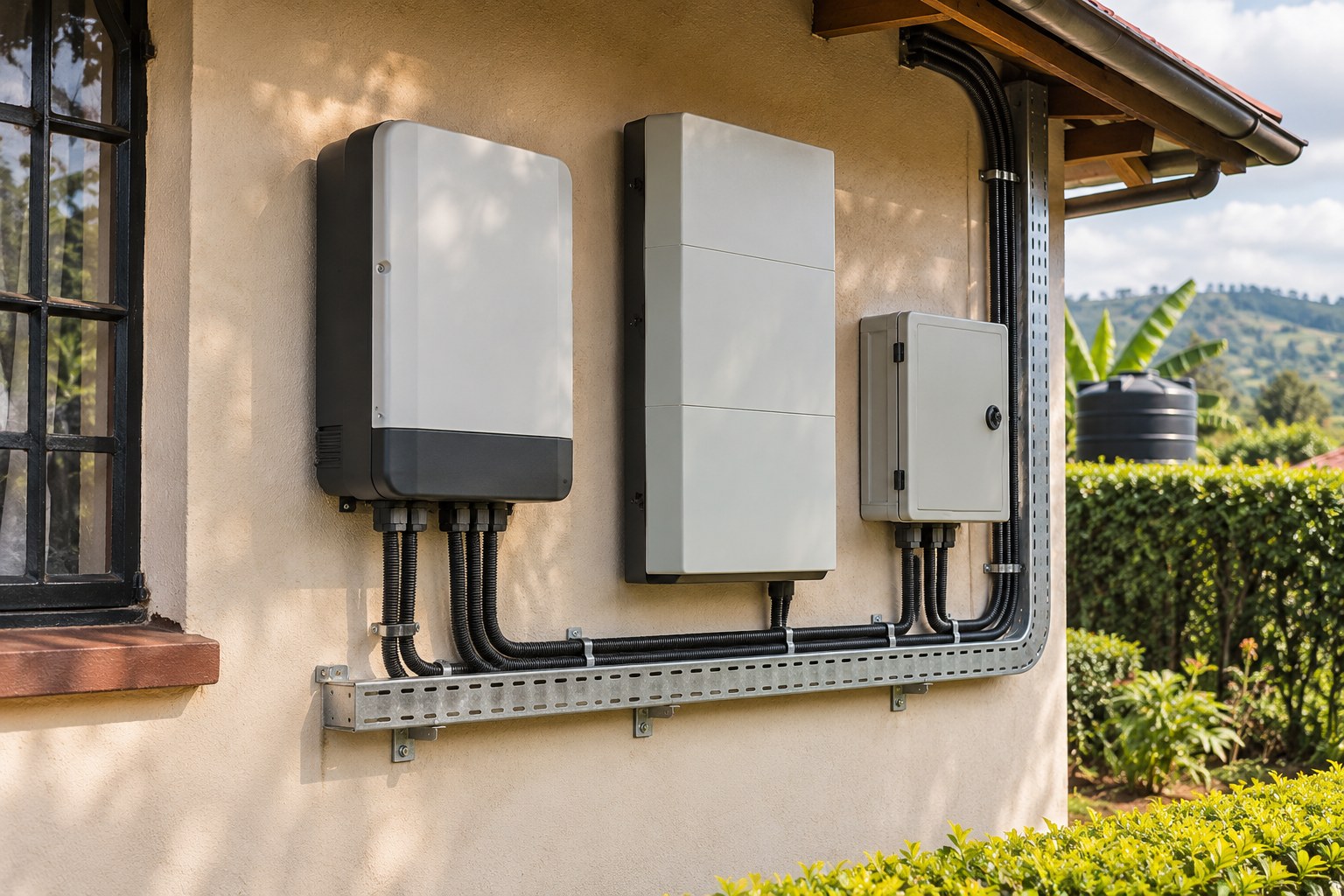
If you are assessing hotel solar refrigeration backup, start with complete service performance during an outage. Prioritise food storage, water, communications and essential guest services with the operational team. Cold-chain compliance needs suitable equipment and temperature procedures in addition to power.
This decision guide was reviewed on 24 November 2026. The worked scenario is illustrative. It is not a measured customer result, an equipment recommendation or a company price offer.
Hotel solar refrigeration backup: the decision to resolve
The practical question is whether the proposed arrangement demonstrates complete service performance during an outage. Begin with the service you need, then ask what evidence would confirm that the proposal can provide it. Avoid replacing that question with a panel count, a product label or an unexplained system-size recommendation.
| Evidence to prepare | How to make the record useful |
|---|---|
| Refrigeration schedule | Provide the actual source record and its date. Distinguish a measurement from an assumption, and identify anything that may change before installation. |
| Guest priorities | Use the relevant units and operating period. Include the limiting condition as well as the convenient survey-day condition. |
| Temperature records | Supply model-specific information where equipment is involved. Keep document revisions and the party responsible for confirming the information. |
| Restart requirements | State the required service and who approves it. Record unresolved questions so the quotation does not silently treat them as settled facts. |
A worked example for hotel solar refrigeration backup
A freezer that remains powered but has a damaged door seal may still perform poorly. Treat the refrigeration condition and the electrical continuity plan as connected but separate acceptance requirements.
The lesson is the role of complete service performance during an outage, not the purchase of a particular product. Replace the scenario assumptions with your own records before making a commitment. Ask the responsible designer to show which conclusion changes when the demand, timing or site condition changes. A sound quotation should make that reasoning visible.
Specify the cooling process before the solar plant
A refrigeration brief needs product throughput, entry conditions, target storage conditions and the required timescale. Heat gain through the room, door activity and equipment performance also matter. The compressor's nameplate is not a complete description of the daily cooling service. A room storing already-cooled stock has a different duty from one repeatedly receiving warm product.
Therefore, coordinate the refrigeration and solar assessments. Record what the product or process specialist requires, then determine the electrical supply needed to support it. Solar output alone cannot prove food safety or product quality. Where the process has a permitted operating range, retain the appropriate temperature and service evidence. A useful design demonstrates the required cooling service under the intended loading and environmental conditions.
Define what backup means at the actual outlets
The word backup needs a circuit-level definition. Some installations support selected essential loads, while others have a broader supply arrangement. An ordinary grid-following PV inverter does not become an independent power source simply because the sun is shining. Grid failure and safe islanded operation require a specifically supported design.
Ask the contractor to identify the backed-up outlets and any loads that remain off during an outage. Also ask about transfer behaviour, restart conditions and low-energy operation. Test the agreed service chain, including networking or controls needed by the main appliance. A camera that stays powered while its recorder fails is not a functioning recording service. A handover demonstration should therefore follow the customer's real operating need rather than display only a running inverter screen.
Control substitutions and unresolved assumptions
A procurement comparison is stronger when every bidder responds to the same assumptions. List the required service, proposed operating conditions and acceptance evidence. Ask bidders to mark departures clearly. Otherwise a lower price may describe a smaller duty, a different warranty or an omitted supporting component.
After selection, keep a written change process. A replacement model can alter dimensions, controls, support or performance. It should not enter the project merely because its headline rating looks similar. Obtain the revised documents and the responsible designer's approval where appropriate. Also close important survey uncertainties before irreversible purchasing decisions. This reduces later arguments about whether the original quote included the work needed to deliver the actual service.
Translate nameplate storage into usable service
Nominal battery energy is the starting point for an assessment, not the final amount available at the loads. The permitted operating window, starting charge, reserved energy and conversion losses affect useful delivery. Obtain the manufacturer's definitions so the same restriction is not applied twice. A figure already described as usable may include an allowance that another supplier applies separately.
However, an energy calculation still needs a power check. A large-capacity battery can have a relatively modest discharge limit. Temperature, state of charge and the supported system configuration may change available performance. Ask for the proposed service in plain terms: which loads, for how long, from what initial condition. Keep those assumptions beside the quoted capacity instead of treating a brand name or chemistry label as a runtime guarantee.
Further reading: US Department of Energy: solar energy and storage basics.
Tie commissioning results to identified equipment
Commissioning records should identify the installation, the relevant equipment, the date and the person responsible. Measurements and tests need an appropriate professional method and a clear acceptance basis. A generic form with unexplained ticks provides less useful evidence than results tied to the actual system and its design requirements.
Keep unresolved findings visible. If an item needs correction or later verification, record who owns the action and when it will be closed. The customer should understand whether the system is accepted, accepted with agreed outstanding items or not yet ready for normal service. This does not require the owner to repeat hazardous tests. It requires a coherent record that supports safe operation, later maintenance and accountability for the installed work.
Choose a reserve policy and a recharge strategy
A backup reserve keeps some energy available for an interruption. This can reduce the energy used for routine bill reduction. The useful choice depends on essential demand, outage experience and the opportunity to recharge. There is no single reserve percentage that suits every home or business. Agree the objective before settings are chosen.
Then consider what happens after a long discharge. The system must supply ongoing loads while restoring the reserve. A design that balances an average day may recover slowly after several weak-generation days. State whether grid or generator charging is available and supported. Ask how operators recognise a low reserve and which actions are authorised. The customer's instructions should explain normal use and escalation, while configuration changes remain with the competent service provider.
Make expansion a defined design scenario
Future readiness needs a named scenario. Describe the additional equipment, operating hours, location and intended service rather than asking for an unspecified percentage of spare capacity. The relevant constraint may be power, energy, roof space, electrical connection, hydraulic duty or control compatibility.
An installation can have room for more modules while lacking capacity at another interface. Therefore, ask which items support the proposed later phase and which will need reassessment, replacement or further approval. Keep that distinction in the design and quotation. This helps the customer avoid paying now for an undefined capability while also preventing a future contractor from treating an old allowance as blanket permission for any expansion.
Keep removed equipment in a traceable disposal chain
When batteries or electrical equipment leave the site, identify who takes custody and what record the owner receives. The new product's delivery note is not evidence of responsible handling of the old one. Ask for the appropriate collection or disposal documentation and use suitable authorised operators for the relevant waste.
The record should distinguish reuse, repair, return to supplier and disposal where those apply. Avoid unsupported claims that a removed asset has been recycled simply because it was collected. Keep the transfer evidence with the service or replacement file. NEMA's published guidance identifies batteries and electronic waste among the materials that require appropriate handling; confirm the applicable current requirements for the actual waste stream.
Further reading: NEMA: appropriate handling of batteries and electronic waste.
Turn the evidence into a clear go-or-no-go decision
For hotel solar refrigeration backup, require an explanation of complete service performance during an outage in the written proposal. A useful answer connects the project records to a stated service boundary. If essential information is missing, the next decision is to obtain the measurement or professional review that resolves it, rather than choose equipment around an optimistic guess.
- Proceed when the relevant evidence supports the proposed service and the responsible parties have closed material design questions.
- Revise the scope when the worked assumptions do not match the real site, operating pattern or equipment limits.
- Request further assessment when permissions, condition, compatibility or critical-service requirements remain unresolved.
Questions buyers ask
What should I prepare before requesting a quotation?
For this assessment, prepare refrigeration schedule, guest priorities, temperature records and restart requirements. Explain the required outcome and any known limitations. Send records from safe accessible sources; a qualified person should collect hazardous measurements or inspect restricted equipment.
What matters most when comparing hotel solar refrigeration backup?
Prioritise food storage, water, communications and essential guest services with the operational team. Cold-chain compliance needs suitable equipment and temperature procedures in addition to power. Compare the alternatives against the same defined service and ask for model-specific supporting evidence. Where proposals use different assumptions, have those differences made explicit before comparing totals.
Can I use the worked example as my final design or price?
No. The example explains a decision method and uses stated assumptions. Your site may have different operating conditions, equipment limits and scope. A final design and quotation need the relevant assessment, written inclusions and applicable approvals.
Prepare your project-specific enquiry
Review our solar for hotels lodges and camps information, then request a site survey with the records listed above. For hotel solar refrigeration backup, explain the required outcome, the property location and the operating constraints. Ask for a written scope, assumptions and exclusions before you commit to equipment.
The solar calculator can help organise a preliminary energy enquiry. Treat its result as an estimate and supply actual load and site records for the final assessment.