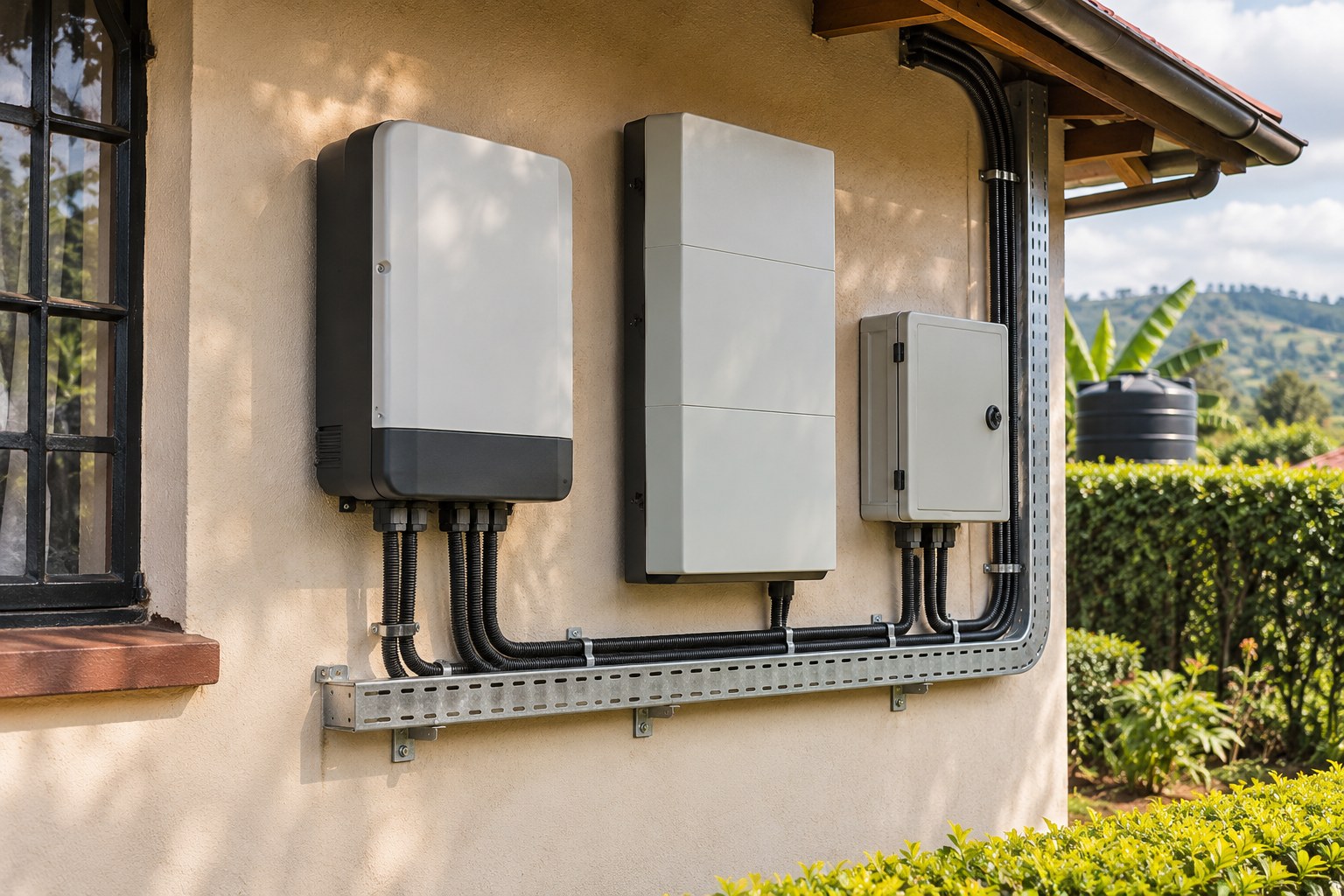
If you are assessing solar for apartment common areas Kenya, start with collective ownership and shared-load measurement. Begin with the owners' authorised common-area supply and a clear list of shared loads. Individual apartment consumption and common services should not be merged casually.
This decision guide was reviewed on 24 November 2026. The worked scenario is illustrative. It is not a measured customer result, an equipment recommendation or a company price offer.
Solar for apartment common areas Kenya: the decision to resolve
The practical question is whether the proposed arrangement demonstrates collective ownership and shared-load measurement. Begin with the service you need, then ask what evidence would confirm that the proposal can provide it. Avoid replacing that question with a panel count, a product label or an unexplained system-size recommendation.
| Evidence to prepare | How to make the record useful |
|---|---|
| Common meter | Provide the actual source record and its date. Distinguish a measurement from an assumption, and identify anything that may change before installation. |
| Lift and pump records | Use the relevant units and operating period. Include the limiting condition as well as the convenient survey-day condition. |
| Owners' approval | Supply model-specific information where equipment is involved. Keep document revisions and the party responsible for confirming the information. |
| Billing responsibility | State the required service and who approves it. Record unresolved questions so the quotation does not silently treat them as settled facts. |
A worked example for solar for apartment common areas Kenya
An estate may have 12 kWh daily lighting demand and 8 kWh pumping demand, but the two occur at different times. An aggregate 20 kWh figure does not establish the required inverter output or storage schedule.
The lesson is the role of collective ownership and shared-load measurement, not the purchase of a particular product. Replace the scenario assumptions with your own records before making a commitment. Ask the responsible designer to show which conclusion changes when the demand, timing or site condition changes. A sound quotation should make that reasoning visible.
Build the energy budget from actual use
Energy and power answer different questions. Energy, measured in kWh, describes consumption over time. Power, measured in kW, describes the rate at a particular moment. Start with the service you need and its operating hours. Then calculate the energy for that defined period. A list of appliance ratings without durations is not a daily energy budget.
For example, a 100 W load running for ten hours consumes 1 kWh. That arithmetic does not establish battery size or inverter suitability. Add the other supported loads and distinguish measured consumption from estimates. Also record equipment that cycles on and off. A refrigerator's printed input rating should not be treated as a measurement of its average daily consumption.
Further reading: US Department of Energy: solar energy and storage basics.
Write down the operating rules people actually need
A useful operator guide explains normal states, permitted user actions, alarms and the route for help. It should use the labels and interfaces found on the actual installation. Avoid a handover that consists only of manufacturer manuals for components the customer is not expected to configure.
For example, the owner may need to recognise a normal stopped pump, a low reserve or a lost monitoring connection. The guide should explain what information to report and when professional attendance is required. It should not encourage unsafe resets, bypasses or live work. Assign a responsible operator and a backup contact where staff or caretakers change. Clear instructions help people use the agreed service without inventing their own operating procedures.
Check simultaneous demand and starting capability
An installation can have enough stored energy yet fail to supply a particular operating combination. The inverter and battery must support the simultaneous load. Motors and some other equipment can add a short starting demand. Ask the designer to state the combinations the system supports, rather than relying on a single headline rating.
Next, separate continuous ratings from short-duration figures. A surge allowance has conditions and a time limit. It is not extra continuous capacity. The connected battery, wiring and protection also impose limits. Record whether a large appliance may operate while another starts. This gives the customer a useful operating boundary and provides a practical basis for the acceptance demonstration. Any live measurements or electrical tests belong to qualified personnel.
Use monitoring to answer a defined operating question
A monitoring system is most useful when the owner knows what each value means. Generation, consumption, import, export, battery flow and state of charge describe different things. The sensor location and the software's definitions matter. Ask the installer to demonstrate the measurements needed for the customer's actual decisions.
Also check what happens when communications fail. Local data storage, remote alerts and historical export can have different availability. Agree who owns the account and who is authorised to receive alerts. A graph can help detect an unusual trend, but it does not replace appropriate physical testing or establish the cause of every fault. Use the records to support a targeted professional assessment, with timestamps and relevant operating context.
Choose a reserve policy and a recharge strategy
A backup reserve keeps some energy available for an interruption. This can reduce the energy used for routine bill reduction. The useful choice depends on essential demand, outage experience and the opportunity to recharge. There is no single reserve percentage that suits every home or business. Agree the objective before settings are chosen.
Then consider what happens after a long discharge. The system must supply ongoing loads while restoring the reserve. A design that balances an average day may recover slowly after several weak-generation days. State whether grid or generator charging is available and supported. Ask how operators recognise a low reserve and which actions are authorised. The customer's instructions should explain normal use and escalation, while configuration changes remain with the competent service provider.
Define what backup means at the actual outlets
The word backup needs a circuit-level definition. Some installations support selected essential loads, while others have a broader supply arrangement. An ordinary grid-following PV inverter does not become an independent power source simply because the sun is shining. Grid failure and safe islanded operation require a specifically supported design.
Ask the contractor to identify the backed-up outlets and any loads that remain off during an outage. Also ask about transfer behaviour, restart conditions and low-energy operation. Test the agreed service chain, including networking or controls needed by the main appliance. A camera that stays powered while its recorder fails is not a functioning recording service. A handover demonstration should therefore follow the customer's real operating need rather than display only a running inverter screen.
Classify critical services with the responsible specialist
Critical-load classification belongs to the people accountable for the service, working with competent technical specialists. A hospital, laboratory, telecom site and domestic home can all need backup, but their permitted interruptions and recovery procedures differ. Do not translate a generic number of backup hours into a promise of uninterrupted operation at every outlet.
Map the whole service chain. Cooling, communications, control equipment and existing UPS interfaces may be essential to the main appliance. Then agree what happens during transfer, low reserve and failure of a supporting component. The acceptance plan should demonstrate the approved arrangement under suitable professional supervision. This provides a clearer assurance than describing the whole building as backed up without identifying what that actually means.
Resolve ownership and access before installation
The physical owner, electricity-account holder, occupier and maintenance decision-maker may be different people. Clarify their roles before work proceeds. A tenant, estate committee or project donor needs an agreed basis for installation access, future inspection, funding and any asset transfer. Energy savings do not automatically settle these responsibilities.
In addition, consider what happens when occupancy or management changes. Equipment records, monitoring access and warranty rights may need an authorised transfer. Avoid a service arrangement that relies solely on one person's private account. Where a lease, ownership agreement or legal obligation requires interpretation, obtain appropriate professional advice. The solar quotation should identify the relevant project responsibilities without pretending to replace the underlying property or governance documents.
Turn the evidence into a clear go-or-no-go decision
For solar for apartment common areas Kenya, require an explanation of collective ownership and shared-load measurement in the written proposal. A useful answer connects the project records to a stated service boundary. If essential information is missing, the next decision is to obtain the measurement or professional review that resolves it, rather than choose equipment around an optimistic guess.
- Proceed when the relevant evidence supports the proposed service and the responsible parties have closed material design questions.
- Revise the scope when the worked assumptions do not match the real site, operating pattern or equipment limits.
- Request further assessment when permissions, condition, compatibility or critical-service requirements remain unresolved.
Questions buyers ask
What should I prepare before requesting a quotation?
For this assessment, prepare common meter, lift and pump records, owners' approval and billing responsibility. Explain the required outcome and any known limitations. Send records from safe accessible sources; a qualified person should collect hazardous measurements or inspect restricted equipment.
What matters most when comparing solar for apartment common areas Kenya?
Begin with the owners' authorised common-area supply and a clear list of shared loads. Individual apartment consumption and common services should not be merged casually. Compare the alternatives against the same defined service and ask for model-specific supporting evidence. Where proposals use different assumptions, have those differences made explicit before comparing totals.
Can I use the worked example as my final design or price?
No. The example explains a decision method and uses stated assumptions. Your site may have different operating conditions, equipment limits and scope. A final design and quotation need the relevant assessment, written inclusions and applicable approvals.
Prepare your project-specific enquiry
Review our solar for apartments and gated communities information, then request a site survey with the records listed above. For solar for apartment common areas Kenya, explain the required outcome, the property location and the operating constraints. Ask for a written scope, assumptions and exclusions before you commit to equipment.
The solar calculator can help organise a preliminary energy enquiry. Treat its result as an estimate and supply actual load and site records for the final assessment.
Reference: EPRA renewable-energy licensing information.
Reference: National Laboratory of the Rockies: photovoltaic performance modelling.