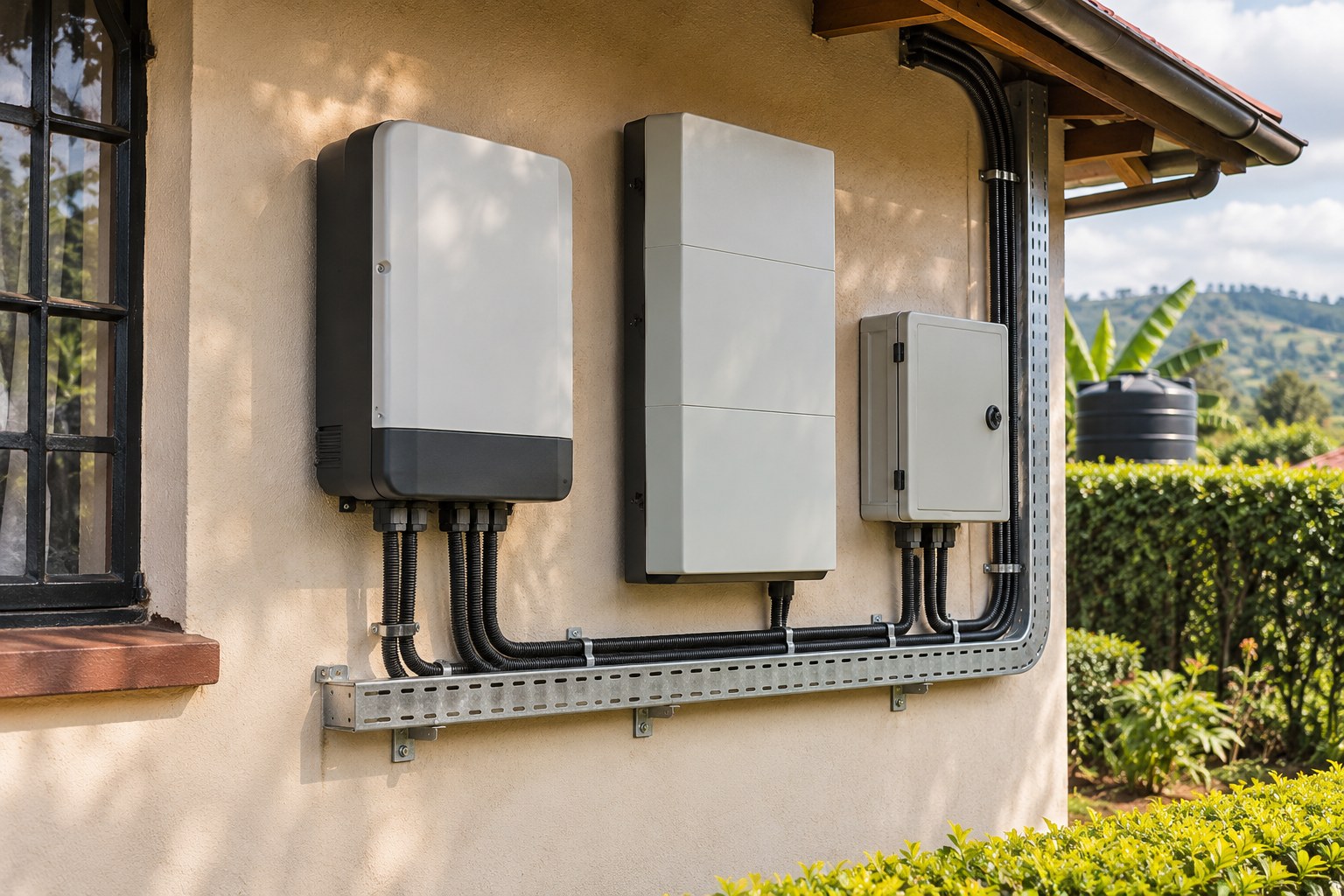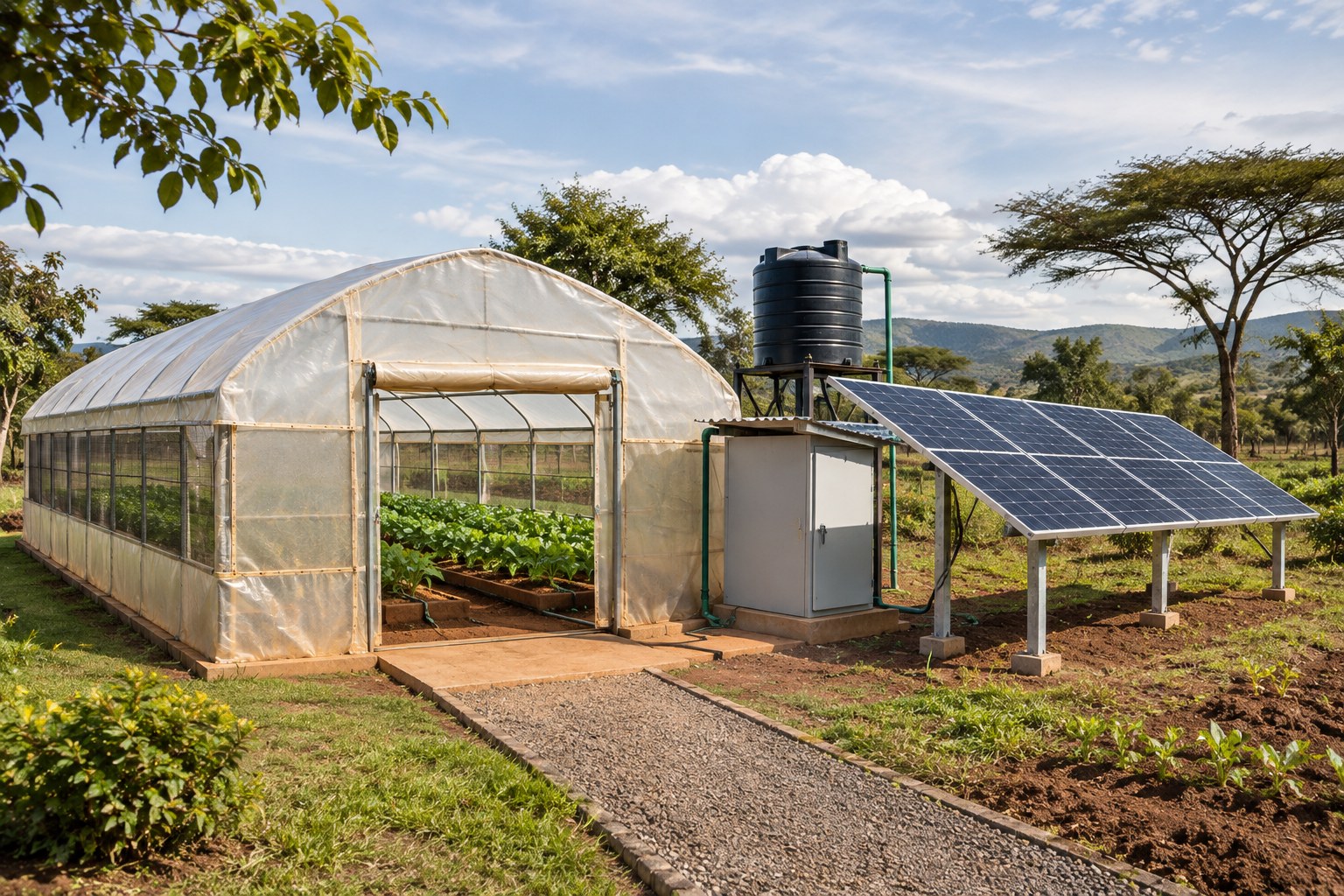
If you are assessing solar greenhouse misting and fertigation, start with intermittent process timing and pump power. Distinguish short control operations from pump starts and sustained irrigation demand. Maintain the agronomist's process requirements when scheduling energy use.
This decision guide was reviewed on 24 November 2026. The worked scenario is illustrative. It is not a measured customer result, an equipment recommendation or a company price offer.
Solar greenhouse misting and fertigation: the decision to resolve
The practical question is whether the proposed arrangement demonstrates intermittent process timing and pump power. Begin with the service you need, then ask what evidence would confirm that the proposal can provide it. Avoid replacing that question with a panel count, a product label or an unexplained system-size recommendation.
| Evidence to prepare | How to make the record useful |
|---|---|
| Pump duty | Provide the actual source record and its date. Distinguish a measurement from an assumption, and identify anything that may change before installation. |
| Pressure requirement | Use the relevant units and operating period. Include the limiting condition as well as the convenient survey-day condition. |
| Control loads | Supply model-specific information where equipment is involved. Keep document revisions and the party responsible for confirming the information. |
| Fertigation timetable | State the required service and who approves it. Record unresolved questions so the quotation does not silently treat them as settled facts. |
A worked example for solar greenhouse misting and fertigation
A pump operating for six five-minute periods runs for half an hour daily, not six hours. However, the inverter still needs to support its starting and running power each time.
The lesson is the role of intermittent process timing and pump power, not the purchase of a particular product. Replace the scenario assumptions with your own records before making a commitment. Ask the responsible designer to show which conclusion changes when the demand, timing or site condition changes. A sound quotation should make that reasoning visible.
Make normal stops distinguishable from protective stops
A system may stop because it has completed its task, because available input is low or because a protective condition exists. Those are different operating states. Ask the supplier to explain the supported control sequence and the information available to the operator. A single undifferentiated fault light can make responsible service decisions difficult.
Then agree how the important functions will be demonstrated professionally. This may include level supervision, demand control, loss of communications or an approved protective test. Customers should not bypass sensors or force unsafe conditions to see what happens. The handover should explain normal user actions, reporting and escalation. It should also identify which settings and tests remain under the authority of qualified service personnel.
Use more than one representative operating condition
Demand and available resources can change through the year. A school, farm, hotel and family home may each have busy and quiet periods. Identify the conditions that matter to the proposed service instead of extending a single favourable day across the whole annual forecast. The same principle applies to source water levels and access conditions.
Then distinguish a normal operating case from a limiting case and a contingency case. Explain which one determines equipment capacity and which one tests resilience. This makes the decision more transparent without pretending that a model predicts every future event. Where local evidence is unavailable, state the assumption and arrange the relevant survey or measurement rather than presenting a regional generalisation as a verified site fact.
Keep customer decisions separate from hazardous technical work
A customer can define needs, inspect documents and report observed symptoms without opening equipment or changing protective settings. Work on live circuits, high-voltage batteries, roofs, pressurised systems and other hazardous installations requires the appropriate qualified personnel and a safe method. A buying guide should not turn a design question into an improvised repair instruction.
For existing faults, record alarms, times and normal operating conditions from safe accessible interfaces. Report visible damage or unusual behaviour through the agreed service route. Follow the approved emergency instructions if the situation presents an immediate hazard. During procurement, ask for the professional test and commissioning evidence that relates to the actual installation. This gives the owner useful assurance without asking them to perform unsafe demonstrations.
Assess environmental exposure rather than using a location stereotype
Coastal and other exposed sites need an assessment of the actual environment, materials and maintenance access. Salt, wind, moisture and corrosion risk can differ substantially between properties in the same region. Ask for supplier evidence and a project-specific review of the proposed materials and fixing arrangement.
In particular, compatible materials, coatings and fasteners belong in the specification. A generic phrase such as marine grade does not explain every component or warranty condition. The owner should understand the required inspection and maintenance plan as well as the initial purchase. Avoid inventing a local weather measurement or assigning an exposure category without evidence. A useful regional guide helps the buyer prepare questions for the specific site assessment.
Compare alternatives at the same useful output
Choose a common service target before comparing options. This might be the same backed-up load and duration, the same delivered water duty, or the same hot-water demand. Equal nameplate power, tank litres or battery labels do not necessarily establish equivalent service. Include the supporting components required by each alternative.
However, avoid forcing every option into an artificial single number. An alternative may offer a different maintenance burden, operating flexibility or continuity arrangement. Describe those differences openly and decide which matter to the customer. A slightly cheaper equipment purchase can become the more expensive operating choice if it needs frequent access, unsupported controls or unavailable spares. The comparison should make the trade-off understandable instead of implying that one technology wins in every situation.
Resolve ownership and access before installation
The physical owner, electricity-account holder, occupier and maintenance decision-maker may be different people. Clarify their roles before work proceeds. A tenant, estate committee or project donor needs an agreed basis for installation access, future inspection, funding and any asset transfer. Energy savings do not automatically settle these responsibilities.
In addition, consider what happens when occupancy or management changes. Equipment records, monitoring access and warranty rights may need an authorised transfer. Avoid a service arrangement that relies solely on one person's private account. Where a lease, ownership agreement or legal obligation requires interpretation, obtain appropriate professional advice. The solar quotation should identify the relevant project responsibilities without pretending to replace the underlying property or governance documents.
Make expansion a defined design scenario
Future readiness needs a named scenario. Describe the additional equipment, operating hours, location and intended service rather than asking for an unspecified percentage of spare capacity. The relevant constraint may be power, energy, roof space, electrical connection, hydraulic duty or control compatibility.
An installation can have room for more modules while lacking capacity at another interface. Therefore, ask which items support the proposed later phase and which will need reassessment, replacement or further approval. Keep that distinction in the design and quotation. This helps the customer avoid paying now for an undefined capability while also preventing a future contractor from treating an old allowance as blanket permission for any expansion.
Match generation to the load timetable
Solar generation changes through the day, while customers use energy on their own schedules. Compare the two profiles instead of subtracting an annual production estimate from annual consumption. The timing matters even when the totals look similar. A large midday surplus cannot automatically supply a load that operates much later.
For a grid-connected installation, unused production may need approved export, supported storage or curtailment. For an independent installation, the energy balance needs an alternative response when demand exceeds supply. Identify flexible loads that can move into daylight without disrupting the service they provide. Also keep genuinely time-sensitive loads separate. Scheduling can improve utilisation, but it should not compromise security, clinical care, product quality or an approved production process.
Further reading: National Laboratory of the Rockies: photovoltaic performance modelling.
Turn the evidence into a clear go-or-no-go decision
For solar greenhouse misting and fertigation, require an explanation of intermittent process timing and pump power in the written proposal. A useful answer connects the project records to a stated service boundary. If essential information is missing, the next decision is to obtain the measurement or professional review that resolves it, rather than choose equipment around an optimistic guess.
- Proceed when the relevant evidence supports the proposed service and the responsible parties have closed material design questions.
- Revise the scope when the worked assumptions do not match the real site, operating pattern or equipment limits.
- Request further assessment when permissions, condition, compatibility or critical-service requirements remain unresolved.
Questions buyers ask
What should I prepare before requesting a quotation?
For this assessment, prepare pump duty, pressure requirement, control loads and fertigation timetable. Explain the required outcome and any known limitations. Send records from safe accessible sources; a qualified person should collect hazardous measurements or inspect restricted equipment.
What matters most when comparing solar greenhouse misting and fertigation?
Distinguish short control operations from pump starts and sustained irrigation demand. Maintain the agronomist's process requirements when scheduling energy use. Compare the alternatives against the same defined service and ask for model-specific supporting evidence. Where proposals use different assumptions, have those differences made explicit before comparing totals.
Can I use the worked example as my final design or price?
No. The example explains a decision method and uses stated assumptions. Your site may have different operating conditions, equipment limits and scope. A final design and quotation need the relevant assessment, written inclusions and applicable approvals.
Prepare your project-specific enquiry
Review our solar power for greenhouses information, then request a site survey with the records listed above. For solar greenhouse misting and fertigation, explain the required outcome, the property location and the operating constraints. Ask for a written scope, assumptions and exclusions before you commit to equipment.
The solar calculator can help organise a preliminary energy enquiry. Treat its result as an estimate and supply actual load and site records for the final assessment.
Reference: EPRA renewable-energy licensing information.