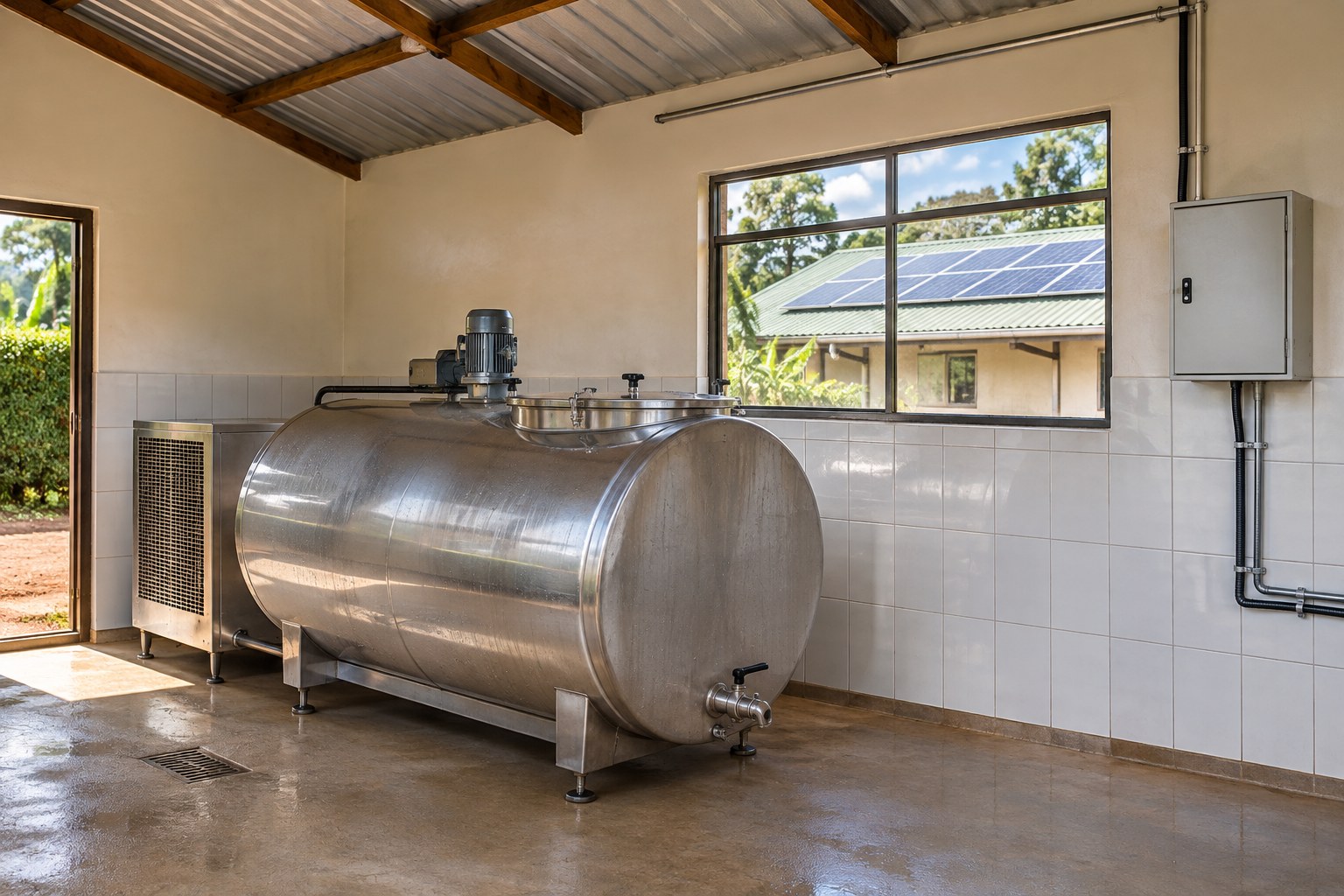
If you are assessing solar milk cooler sizing Kenya, start with the cooling duty of each arriving batch. Size the refrigeration service around milk arrival, cooling duty and collection timing, with a dairy specialist confirming the required process conditions.
This decision guide was reviewed on 24 November 2026. The worked scenario is illustrative. It is not a measured customer result, an equipment recommendation or a company price offer.
Solar milk cooler sizing Kenya: the decision to resolve
The practical question is whether the proposed arrangement demonstrates the cooling duty of each arriving batch. Begin with the service you need, then ask what evidence would confirm that the proposal can provide it. Avoid replacing that question with a panel count, a product label or an unexplained system-size recommendation.
| Evidence to prepare | How to make the record useful |
|---|---|
| Batch litres | Provide the actual source record and its date. Distinguish a measurement from an assumption, and identify anything that may change before installation. |
| Arrival temperature | Use the relevant units and operating period. Include the limiting condition as well as the convenient survey-day condition. |
| Collection times | Supply model-specific information where equipment is involved. Keep document revisions and the party responsible for confirming the information. |
| Equipment cooling performance | State the required service and who approves it. Record unresolved questions so the quotation does not silently treat them as settled facts. |
A worked example for solar milk cooler sizing Kenya
Cooling an assumed 200 kg batch through 25°C at an illustrative specific heat of 3.9 kJ/kg°C removes about 5.42 kWh of sensible heat. Electrical demand also depends on refrigeration efficiency and other heat gains.
The lesson is the role of the cooling duty of each arriving batch, not the purchase of a particular product. Replace the scenario assumptions with your own records before making a commitment. Ask the responsible designer to show which conclusion changes when the demand, timing or site condition changes. A sound quotation should make that reasoning visible.
Distinguish thermal energy from electricity
Hot water and refrigeration involve a thermal service. The useful heat transferred is not automatically equal to the electricity consumed. Collector performance, storage loss, refrigeration efficiency and operating conditions affect the relationship. Keep thermal and electrical units explicit so an attractive equipment label does not conceal the real duty.
For an educational water-heating calculation, water mass, temperature rise and specific heat give an estimate of sensible heat. The real installation also has storage, pipework and control effects. For cooling, product throughput and heat gains matter alongside the desired temperature change. Have the relevant specialist establish the process conditions before the solar energy requirement is finalised. A simplified worked example explains the method; it does not replace a complete thermal design.
Specify the cooling process before the solar plant
A refrigeration brief needs product throughput, entry conditions, target storage conditions and the required timescale. Heat gain through the room, door activity and equipment performance also matter. The compressor's nameplate is not a complete description of the daily cooling service. A room storing already-cooled stock has a different duty from one repeatedly receiving warm product.
Therefore, coordinate the refrigeration and solar assessments. Record what the product or process specialist requires, then determine the electrical supply needed to support it. Solar output alone cannot prove food safety or product quality. Where the process has a permitted operating range, retain the appropriate temperature and service evidence. A useful design demonstrates the required cooling service under the intended loading and environmental conditions.
Write down the operating rules people actually need
A useful operator guide explains normal states, permitted user actions, alarms and the route for help. It should use the labels and interfaces found on the actual installation. Avoid a handover that consists only of manufacturer manuals for components the customer is not expected to configure.
For example, the owner may need to recognise a normal stopped pump, a low reserve or a lost monitoring connection. The guide should explain what information to report and when professional attendance is required. It should not encourage unsafe resets, bypasses or live work. Assign a responsible operator and a backup contact where staff or caretakers change. Clear instructions help people use the agreed service without inventing their own operating procedures.
Distinguish acknowledgement, attendance and restoration
Support promises need precise definitions. An acknowledged alarm, an engineer's arrival and restored service are different events. Parts availability, site access, communications and the cause of the fault can affect each one. Ask the provider to state the actual commitment and its conditions rather than relying on words such as immediate support.
For a remote or critical site, agree an escalation path and a practical contingency. Identify who can authorise access, which symptoms require urgent action and who manages the affected service until repair. Do not invent a response time that the business has not approved. A clear service arrangement is valuable precisely because it describes what can be delivered and what the customer must provide when something goes wrong.
Keep data intervals, timestamps and meter boundaries consistent
A useful operating record identifies the quantity, measurement point, units and time basis. Import, generation, export and storage flow should not be mixed casually. If different files use different timezones or intervals, align them before comparing the values. Otherwise a calculation can assign production to the wrong consumption period.
Next, check for gaps, resets, duplicated readings or estimates. Preserve the original export and explain how any cleaning or aggregation was done. This is especially important when data support a savings, warranty or performance claim. A chart is a helpful presentation, but the underlying records make the conclusion auditable. Ask for export access and a retention arrangement that survives a change of staff or service provider.
Classify critical services with the responsible specialist
Critical-load classification belongs to the people accountable for the service, working with competent technical specialists. A hospital, laboratory, telecom site and domestic home can all need backup, but their permitted interruptions and recovery procedures differ. Do not translate a generic number of backup hours into a promise of uninterrupted operation at every outlet.
Map the whole service chain. Cooling, communications, control equipment and existing UPS interfaces may be essential to the main appliance. Then agree what happens during transfer, low reserve and failure of a supporting component. The acceptance plan should demonstrate the approved arrangement under suitable professional supervision. This provides a clearer assurance than describing the whole building as backed up without identifying what that actually means.
Build the energy budget from actual use
Energy and power answer different questions. Energy, measured in kWh, describes consumption over time. Power, measured in kW, describes the rate at a particular moment. Start with the service you need and its operating hours. Then calculate the energy for that defined period. A list of appliance ratings without durations is not a daily energy budget.
For example, a 100 W load running for ten hours consumes 1 kWh. That arithmetic does not establish battery size or inverter suitability. Add the other supported loads and distinguish measured consumption from estimates. Also record equipment that cycles on and off. A refrigerator's printed input rating should not be treated as a measurement of its average daily consumption.
Further reading: US Department of Energy: solar energy and storage basics.
Make normal stops distinguishable from protective stops
A system may stop because it has completed its task, because available input is low or because a protective condition exists. Those are different operating states. Ask the supplier to explain the supported control sequence and the information available to the operator. A single undifferentiated fault light can make responsible service decisions difficult.
Then agree how the important functions will be demonstrated professionally. This may include level supervision, demand control, loss of communications or an approved protective test. Customers should not bypass sensors or force unsafe conditions to see what happens. The handover should explain normal user actions, reporting and escalation. It should also identify which settings and tests remain under the authority of qualified service personnel.
Turn the evidence into a clear go-or-no-go decision
For solar milk cooler sizing Kenya, require an explanation of the cooling duty of each arriving batch in the written proposal. A useful answer connects the project records to a stated service boundary. If essential information is missing, the next decision is to obtain the measurement or professional review that resolves it, rather than choose equipment around an optimistic guess.
- Proceed when the relevant evidence supports the proposed service and the responsible parties have closed material design questions.
- Revise the scope when the worked assumptions do not match the real site, operating pattern or equipment limits.
- Request further assessment when permissions, condition, compatibility or critical-service requirements remain unresolved.
Questions buyers ask
What should I prepare before requesting a quotation?
For this assessment, prepare batch litres, arrival temperature, collection times and equipment cooling performance. Explain the required outcome and any known limitations. Send records from safe accessible sources; a qualified person should collect hazardous measurements or inspect restricted equipment.
What matters most when comparing solar milk cooler sizing Kenya?
Size the refrigeration service around milk arrival, cooling duty and collection timing, with a dairy specialist confirming the required process conditions. Compare the alternatives against the same defined service and ask for model-specific supporting evidence. Where proposals use different assumptions, have those differences made explicit before comparing totals.
Can I use the worked example as my final design or price?
No. The example explains a decision method and uses stated assumptions. Your site may have different operating conditions, equipment limits and scope. A final design and quotation need the relevant assessment, written inclusions and applicable approvals.
Prepare your project-specific enquiry
Review our solar cold rooms and milk coolers information, then request a site survey with the records listed above. For solar milk cooler sizing Kenya, explain the required outcome, the property location and the operating constraints. Ask for a written scope, assumptions and exclusions before you commit to equipment.
Reference: EPRA renewable-energy licensing information.
Reference: WHO: refrigerators, freezers and temperature monitoring.