If you are assessing solar panel cleaning performance comparison, start with a fair assessment of the cleaning contribution. Compare like-for-like conditions and a suitable reference period. A sunnier day after cleaning is not evidence of the cleaning effect by itself.
This decision guide was reviewed on 24 November 2026. The worked scenario is illustrative. It is not a measured customer result, an equipment recommendation or a company price offer.
Solar panel cleaning performance comparison: the decision to resolve
The practical question is whether the proposed arrangement demonstrates a fair assessment of the cleaning contribution. Begin with the service you need, then ask what evidence would confirm that the proposal can provide it. Avoid replacing that question with a panel count, a product label or an unexplained system-size recommendation.
| Evidence to prepare | How to make the record useful |
|---|---|
| Irradiance or weather context | Provide the actual source record and its date. Distinguish a measurement from an assumption, and identify anything that may change before installation. |
| Inverter records | Use the relevant units and operating period. Include the limiting condition as well as the convenient survey-day condition. |
| Fault history | Supply model-specific information where equipment is involved. Keep document revisions and the party responsible for confirming the information. |
| Comparison window | State the required service and who approves it. Record unresolved questions so the quotation does not silently treat them as settled facts. |
A worked example for solar panel cleaning performance comparison
If output increases from 18 to 24 kWh while solar conditions also improve, the six-kWh change cannot all be credited to washing. Explain the comparison method and other changes that occurred.
The lesson is the role of a fair assessment of the cleaning contribution, not the purchase of a particular product. Replace the scenario assumptions with your own records before making a commitment. Ask the responsible designer to show which conclusion changes when the demand, timing or site condition changes. A sound quotation should make that reasoning visible.
Agree a fair baseline before claiming savings
A baseline describes the service and consumption against which a change will be assessed. Record the period, meter boundaries, operating activity and known unusual events before work starts. Otherwise a later bill reduction can be attributed to the wrong cause. Lower occupancy, fewer production hours or a change in tariff can alter the result independently of solar.
Therefore, agree how the comparison will handle such changes. A factory may need production data; a lodge may need occupied room-nights; a pumping project may need delivered water volume and head. Select a measure that reflects the actual service. Report missing data and uncertainty rather than filling gaps with an optimistic assumption. This makes performance review more useful to the customer and prevents an attractive headline from hiding a weak comparison.
Judge cleaning against site conditions and a fair comparison
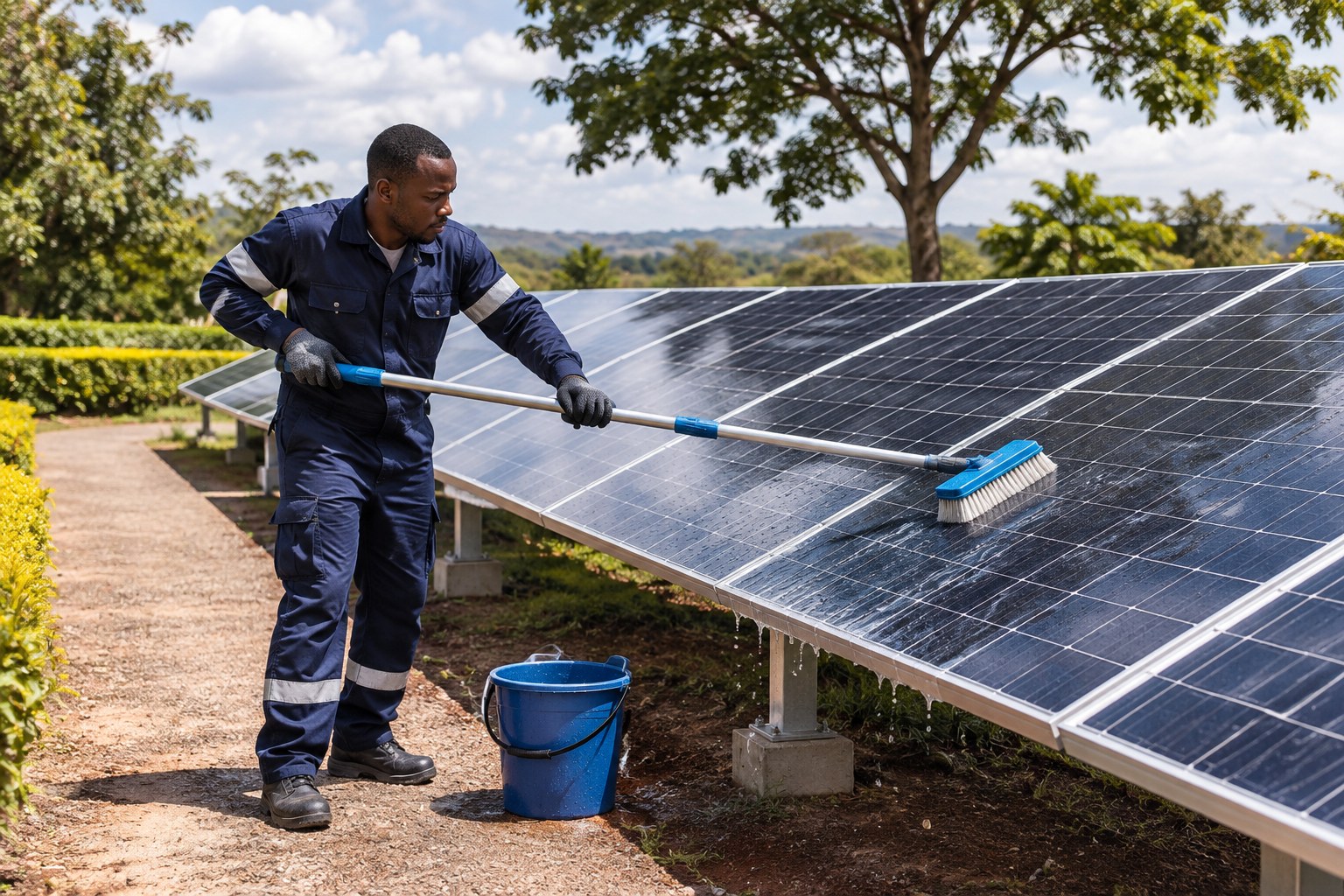
Cleaning requirements vary with exposure, manufacturer guidance and safe access. Dust, deposits and local conditions do not affect every array equally. Use inspection findings and relevant operating records to decide whether an intervention is justified. A fixed interval copied from another roof is not evidence of the appropriate schedule for this one.
If production is compared before and after cleaning, account for the change in solar conditions and any other work performed. A sunnier day can improve output independently of cleaning. Keep the scope clear: surface cleaning is not automatically a complete electrical inspection or repair. Qualified contractors should define safe access and the approved method, while the customer receives useful evidence of completed work and any defects observed.
Make expansion a defined design scenario
Future readiness needs a named scenario. Describe the additional equipment, operating hours, location and intended service rather than asking for an unspecified percentage of spare capacity. The relevant constraint may be power, energy, roof space, electrical connection, hydraulic duty or control compatibility.
An installation can have room for more modules while lacking capacity at another interface. Therefore, ask which items support the proposed later phase and which will need reassessment, replacement or further approval. Keep that distinction in the design and quotation. This helps the customer avoid paying now for an undefined capability while also preventing a future contractor from treating an old allowance as blanket permission for any expansion.
Resolve ownership and access before installation
The physical owner, electricity-account holder, occupier and maintenance decision-maker may be different people. Clarify their roles before work proceeds. A tenant, estate committee or project donor needs an agreed basis for installation access, future inspection, funding and any asset transfer. Energy savings do not automatically settle these responsibilities.
In addition, consider what happens when occupancy or management changes. Equipment records, monitoring access and warranty rights may need an authorised transfer. Avoid a service arrangement that relies solely on one person's private account. Where a lease, ownership agreement or legal obligation requires interpretation, obtain appropriate professional advice. The solar quotation should identify the relevant project responsibilities without pretending to replace the underlying property or governance documents.
Keep removed equipment in a traceable disposal chain
When batteries or electrical equipment leave the site, identify who takes custody and what record the owner receives. The new product's delivery note is not evidence of responsible handling of the old one. Ask for the appropriate collection or disposal documentation and use suitable authorised operators for the relevant waste.
The record should distinguish reuse, repair, return to supplier and disposal where those apply. Avoid unsupported claims that a removed asset has been recycled simply because it was collected. Keep the transfer evidence with the service or replacement file. NEMA's published guidance identifies batteries and electronic waste among the materials that require appropriate handling; confirm the applicable current requirements for the actual waste stream.
Further reading: NEMA: appropriate handling of batteries and electronic waste.
Require support for the exact equipment combination
Compatibility is more than a matching voltage label or connector. Ask for the complete model codes, supported operating limits, communications requirements and relevant firmware versions. The documents should describe the combination being supplied. General statements that two manufacturers are compatible are weaker evidence than model-specific instructions.
In addition, establish who takes responsibility for integration. The battery manufacturer, inverter supplier and installer may have different warranty obligations. A working demonstration does not erase an unsupported configuration. Keep the relevant document revisions with the handover file. If any proposed substitution changes the model, controls or limits, ask for a fresh compatibility review before accepting it. Manufacturer guidance illustrates why these checks need to be specific; it is not a claim that the business has a partnership with that manufacturer.
Further reading: Victron Energy: battery compatibility documentation.
Separate the electricity bill into relevant components
Use the customer's actual tariff category and bill history when estimating avoided costs. The average amount paid divided by imported kWh may combine energy charges with other items. A reduction in energy imports does not necessarily remove every charge. Demand-related charges also require attention to when the site's peak occurs.
For example, a PV array may reduce daytime purchases without eliminating an evening demand peak. Show self-consumed energy, approved exports and remaining purchases separately. Use current applicable information from the utility and regulator. Where that evidence is missing, retain a clearly labelled assumption rather than presenting it as the current Kenyan electricity price. A transparent estimate explains the relationship between the physical energy model and the financial calculation.
Further reading: EPRA electricity tariff guidance.
Separate asset condition from the wish for an upgrade
An upgrade and a repair solve different problems. A failed component may need replacement, but a larger system is not automatically the right response. Establish the existing condition, supported configuration and actual service shortfall first. This helps the customer distinguish a necessary intervention from optional additional capability.
For a battery or inverter change, compare the retained equipment's compatibility, age, support and warranty with the proposed replacement. A broader redesign may be justified, but the explanation should identify why. Ask which tests support the diagnosis and which new operating conditions will be demonstrated. The resulting quotation should state the removed and retained assets clearly, including any responsible disposal and updated handover records.
Turn the evidence into a clear go-or-no-go decision
For solar panel cleaning performance comparison, require an explanation of a fair assessment of the cleaning contribution in the written proposal. A useful answer connects the project records to a stated service boundary. If essential information is missing, the next decision is to obtain the measurement or professional review that resolves it, rather than choose equipment around an optimistic guess.
- Proceed when the relevant evidence supports the proposed service and the responsible parties have closed material design questions.
- Revise the scope when the worked assumptions do not match the real site, operating pattern or equipment limits.
- Request further assessment when permissions, condition, compatibility or critical-service requirements remain unresolved.
Questions buyers ask
What should I prepare before requesting a quotation?
For this assessment, prepare irradiance or weather context, inverter records, fault history and comparison window. Explain the required outcome and any known limitations. Send records from safe accessible sources; a qualified person should collect hazardous measurements or inspect restricted equipment.
What matters most when comparing solar panel cleaning performance comparison?
Compare like-for-like conditions and a suitable reference period. A sunnier day after cleaning is not evidence of the cleaning effect by itself. Compare the alternatives against the same defined service and ask for model-specific supporting evidence. Where proposals use different assumptions, have those differences made explicit before comparing totals.
Can I use the worked example as my final design or price?
No. The example explains a decision method and uses stated assumptions. Your site may have different operating conditions, equipment limits and scope. A final design and quotation need the relevant assessment, written inclusions and applicable approvals.
Prepare your project-specific enquiry
Review our solar panel cleaning information, then request a site survey with the records listed above. For solar panel cleaning performance comparison, explain the required outcome, the property location and the operating constraints. Ask for a written scope, assumptions and exclusions before you commit to equipment.
The solar calculator can help organise a preliminary energy enquiry. Treat its result as an estimate and supply actual load and site records for the final assessment.