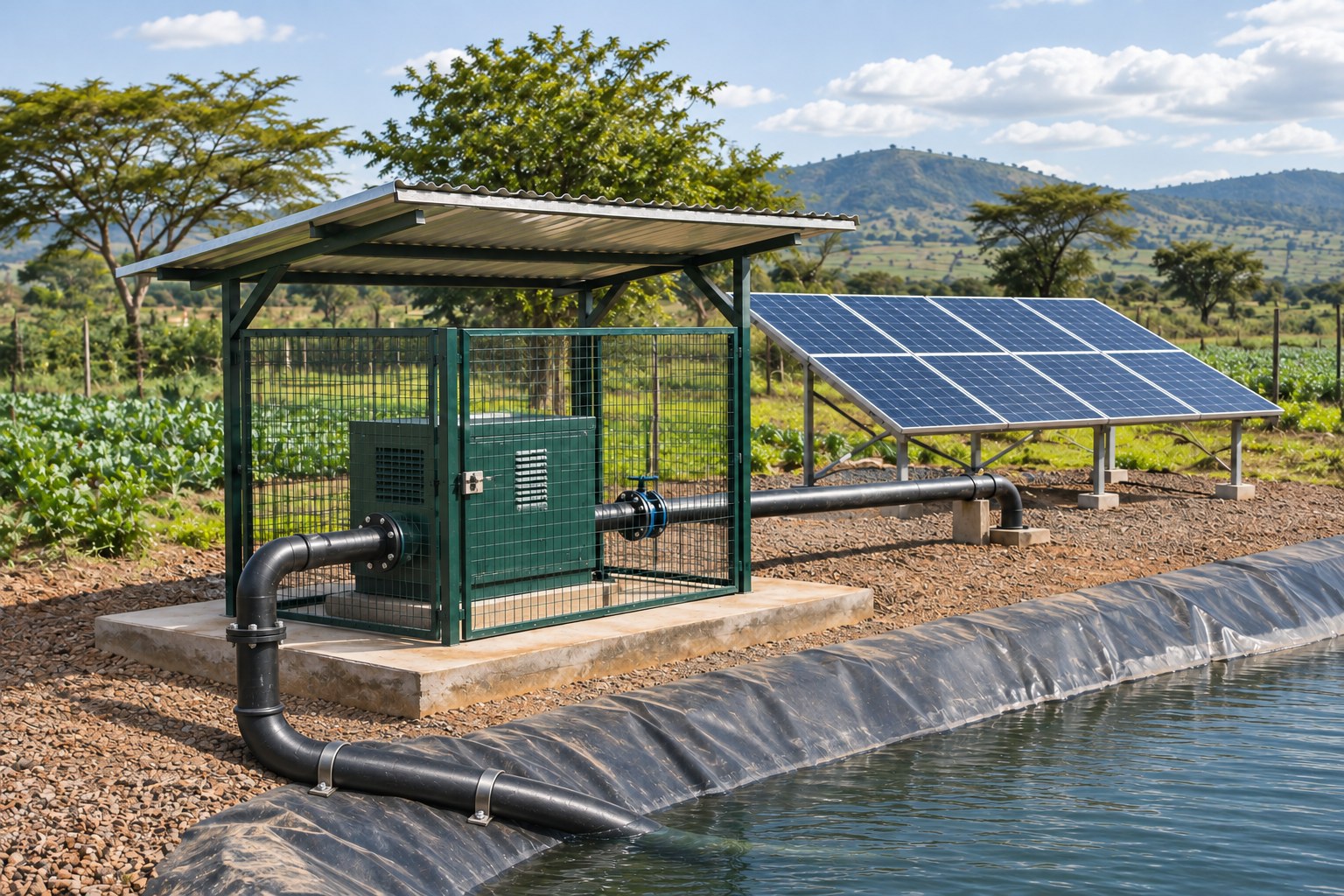
If you are assessing solar surface pump suction conditions, start with performance at the limiting source level. Review suction lift, pipe losses, priming requirements and source-level changes with a qualified pump designer. A larger motor does not cure an unsuitable suction arrangement.
This decision guide was reviewed on 24 November 2026. The worked scenario is illustrative. It is not a measured customer result, an equipment recommendation or a company price offer.
Solar surface pump suction conditions: the decision to resolve
The practical question is whether the proposed arrangement demonstrates performance at the limiting source level. Begin with the service you need, then ask what evidence would confirm that the proposal can provide it. Avoid replacing that question with a panel count, a product label or an unexplained system-size recommendation.
| Evidence to prepare | How to make the record useful |
|---|---|
| Lowest water level | Provide the actual source record and its date. Distinguish a measurement from an assumption, and identify anything that may change before installation. |
| Suction pipe route | Use the relevant units and operating period. Include the limiting condition as well as the convenient survey-day condition. |
| Strainer condition | Supply model-specific information where equipment is involved. Keep document revisions and the party responsible for confirming the information. |
| Manufacturer limits | State the required service and who approves it. Record unresolved questions so the quotation does not silently treat them as settled facts. |
A worked example for solar surface pump suction conditions
A pump positioned close to a dam during the wet season may face a much longer suction route later. Reassess the intended operating envelope rather than assuming the wet-season demonstration proves year-round service.
The lesson is the role of performance at the limiting source level, not the purchase of a particular product. Replace the scenario assumptions with your own records before making a commitment. Ask the responsible designer to show which conclusion changes when the demand, timing or site condition changes. A sound quotation should make that reasoning visible.
Define delivered water before choosing pumping equipment
Start with the daily useful volume, the delivery points and the time when users need water. Then assess whether the source can support that demand sustainably. A pump's motor rating is not a daily delivery specification. Its flow changes with the hydraulic duty and available operating conditions.
For solar pumping, the effective operating period can vary with weather and control limits. Storage may separate pumping time from use, but it brings its own usable-volume and delivery-pressure requirements. Ask the designer to show a credible daily water balance. Where the input data are uncertain, identify the additional survey or professional interpretation needed. A larger array should not be used to justify abstraction beyond the source's tested capacity or applicable permission.
Further reading: Water Resources Authority: permitting and water-use allocation.
Use the operating head, not borehole depth alone
Total dynamic head accounts for the water lift to the delivery point and the relevant losses at the intended flow. In a borehole, the pumping water level matters; total drilled depth alone does not give the operating head. Delivery elevation, pipework and required outlet conditions add other parts of the duty.
Consequently, a pump selection needs a marked duty point on suitable manufacturer performance information. Maximum head and maximum flow are different ends of a performance description, not a guaranteed simultaneous output. Ask the responsible designer to explain how the source records and delivery route produce the selected duty. This is more useful than requesting a pump by horsepower and expecting the required litres to follow automatically.
Use more than one representative operating condition
Demand and available resources can change through the year. A school, farm, hotel and family home may each have busy and quiet periods. Identify the conditions that matter to the proposed service instead of extending a single favourable day across the whole annual forecast. The same principle applies to source water levels and access conditions.
Then distinguish a normal operating case from a limiting case and a contingency case. Explain which one determines equipment capacity and which one tests resilience. This makes the decision more transparent without pretending that a model predicts every future event. Where local evidence is unavailable, state the assumption and arrange the relevant survey or measurement rather than presenting a regional generalisation as a verified site fact.
Keep data intervals, timestamps and meter boundaries consistent
A useful operating record identifies the quantity, measurement point, units and time basis. Import, generation, export and storage flow should not be mixed casually. If different files use different timezones or intervals, align them before comparing the values. Otherwise a calculation can assign production to the wrong consumption period.
Next, check for gaps, resets, duplicated readings or estimates. Preserve the original export and explain how any cleaning or aggregation was done. This is especially important when data support a savings, warranty or performance claim. A chart is a helpful presentation, but the underlying records make the conclusion auditable. Ask for export access and a retention arrangement that survives a change of staff or service provider.
Check pressure and hydraulic compatibility
Pressure suitability depends on the actual supply and the permitted arrangement of every relevant component. A larger tank or a more powerful pump does not resolve an incompatible pressure rating. Ask the specialist to assess the source, booster equipment, operating levels and delivery requirements together.
In a hot-water installation, storage support, pipework, fittings and the manufacturer's safety arrangements also matter. Terms such as pressurised, non-pressurised, direct and indirect describe different aspects of a system. They should not be treated as interchangeable product tiers. Obtain the supported configuration for the building and the required service. The owner should receive approved operating and maintenance information, without being asked to adjust pressure controls or modify plumbing safety devices.
Make expansion a defined design scenario
Future readiness needs a named scenario. Describe the additional equipment, operating hours, location and intended service rather than asking for an unspecified percentage of spare capacity. The relevant constraint may be power, energy, roof space, electrical connection, hydraulic duty or control compatibility.
An installation can have room for more modules while lacking capacity at another interface. Therefore, ask which items support the proposed later phase and which will need reassessment, replacement or further approval. Keep that distinction in the design and quotation. This helps the customer avoid paying now for an undefined capability while also preventing a future contractor from treating an old allowance as blanket permission for any expansion.
Define an observable acceptance test
Acceptance should demonstrate the service the customer agreed to buy. Identify the test conditions, measurements, responsible witnesses and the evidence that will be retained. A dashboard showing normal status is useful, but it may not prove backup duration, delivered water, temperature continuity or a correctly functioning control sequence.
In practice, the test needs appropriate professional planning. Do not ask a customer to create unsafe faults, alter live wiring or bypass protection. Instead, have competent personnel test the agreed functions through a supported procedure. Record defects and the authority for return to service. If conditions prevent a meaningful performance test on the first visit, document the outstanding verification rather than quietly treating it as complete. A clear acceptance record protects both the buyer and the contractor.
Compare installed scope rather than headline package names
Ask each bidder to define the same service boundary. Equipment, mounting, protection, cabling, labour, access, transport, approvals, testing and aftercare can appear in different places in a quotation. An equipment-only price is not directly comparable with a commissioned installation. Missing items can explain a price difference without showing that either option is better value.
Also obtain written exclusions and the basis of any taxes. The quote should identify the exact equipment and the customer's responsibilities. If the site needs roof repairs, civil work, a distribution-board change or additional investigations, establish who prices and approves that work. A useful comparison keeps these differences visible. The goal is a complete agreed service at an understood cost, rather than choosing the smallest number beside a familiar system-size label.
Turn the evidence into a clear go-or-no-go decision
For solar surface pump suction conditions, require an explanation of performance at the limiting source level in the written proposal. A useful answer connects the project records to a stated service boundary. If essential information is missing, the next decision is to obtain the measurement or professional review that resolves it, rather than choose equipment around an optimistic guess.
- Proceed when the relevant evidence supports the proposed service and the responsible parties have closed material design questions.
- Revise the scope when the worked assumptions do not match the real site, operating pattern or equipment limits.
- Request further assessment when permissions, condition, compatibility or critical-service requirements remain unresolved.
Questions buyers ask
What should I prepare before requesting a quotation?
For this assessment, prepare lowest water level, suction pipe route, strainer condition and manufacturer limits. Explain the required outcome and any known limitations. Send records from safe accessible sources; a qualified person should collect hazardous measurements or inspect restricted equipment.
What matters most when comparing solar surface pump suction conditions?
Review suction lift, pipe losses, priming requirements and source-level changes with a qualified pump designer. A larger motor does not cure an unsuitable suction arrangement. Compare the alternatives against the same defined service and ask for model-specific supporting evidence. Where proposals use different assumptions, have those differences made explicit before comparing totals.
Can I use the worked example as my final design or price?
No. The example explains a decision method and uses stated assumptions. Your site may have different operating conditions, equipment limits and scope. A final design and quotation need the relevant assessment, written inclusions and applicable approvals.
Prepare your project-specific enquiry
Review our solar surface pumps information, then request a site survey with the records listed above. For solar surface pump suction conditions, explain the required outcome, the property location and the operating constraints. Ask for a written scope, assumptions and exclusions before you commit to equipment.
Reference: EPRA renewable-energy licensing information.