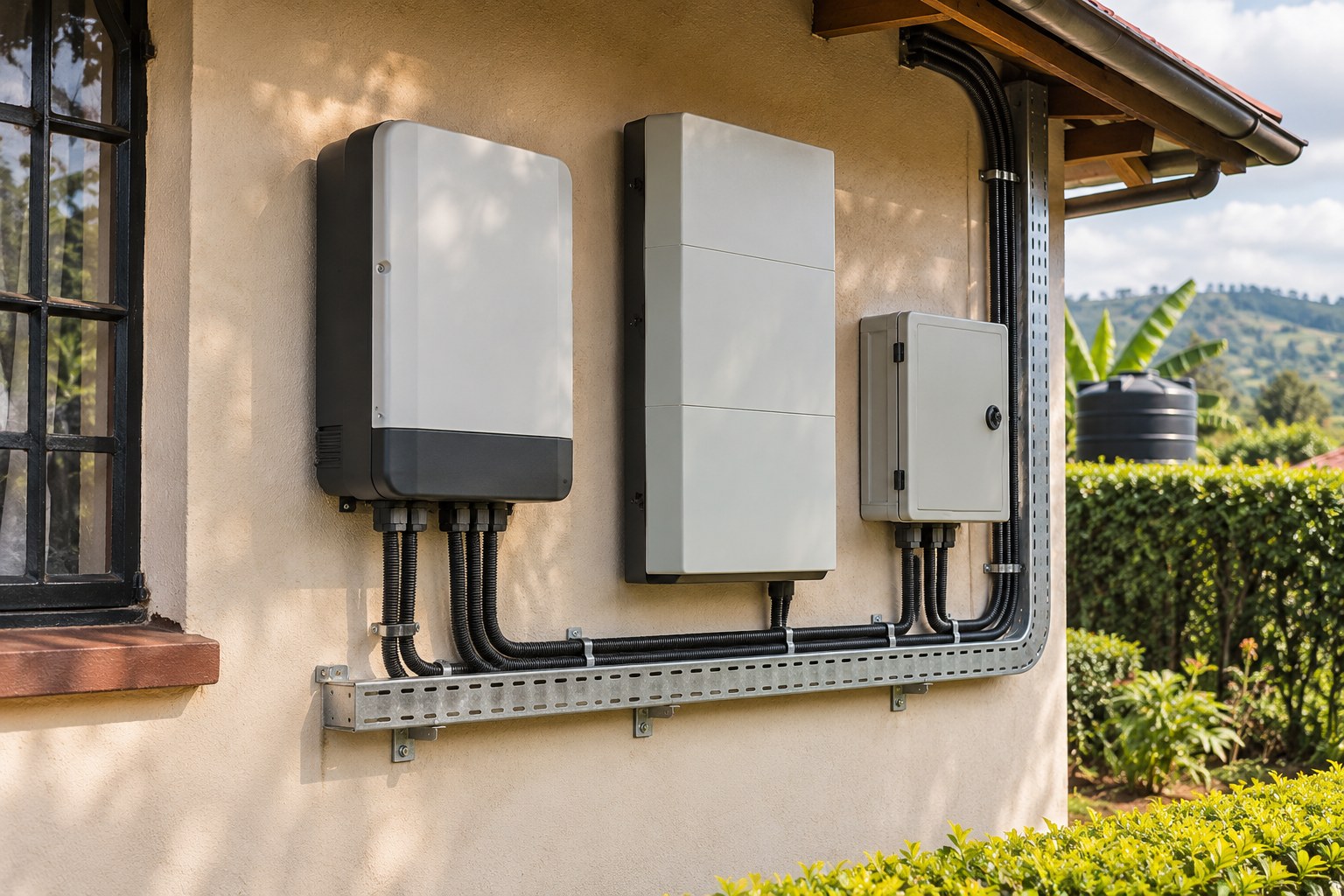
If you are assessing ground-mounted vs rooftop solar, start with whole-site installed cost and operating constraints. Compare usable space, structural work, cable routes, security, drainage and future expansion; neither location is inherently the cheapest installed option.
This decision guide was reviewed on 24 November 2026. The worked scenario is illustrative. It is not a measured customer result, an equipment recommendation or a company price offer.
Ground-mounted vs rooftop solar: the decision to resolve
The practical question is whether the proposed arrangement demonstrates whole-site installed cost and operating constraints. Begin with the service you need, then ask what evidence would confirm that the proposal can provide it. Avoid replacing that question with a panel count, a product label or an unexplained system-size recommendation.
| Evidence to prepare | How to make the record useful |
|---|---|
| Roof capacity | Provide the actual source record and its date. Distinguish a measurement from an assumption, and identify anything that may change before installation. |
| Ground access | Use the relevant units and operating period. Include the limiting condition as well as the convenient survey-day condition. |
| Cable distance | Supply model-specific information where equipment is involved. Keep document revisions and the party responsible for confirming the information. |
| Future site plans | State the required service and who approves it. Record unresolved questions so the quotation does not silently treat them as settled facts. |
A worked example for ground-mounted vs rooftop solar
A roof option may need reinforcement, while a ground option may require a long protected cable route and fencing. Compare both complete scopes instead of comparing mounting frames alone.
The lesson is the role of whole-site installed cost and operating constraints, not the purchase of a particular product. Replace the scenario assumptions with your own records before making a commitment. Ask the responsible designer to show which conclusion changes when the demand, timing or site condition changes. A sound quotation should make that reasoning visible.
Understand the phase arrangement before comparing ratings
Single-phase and three-phase equipment cannot be compared only by total kW. The building's supply, the load distribution and the supported inverter arrangement all matter. Some equipment has per-phase limits or specific balance requirements. A combined system rating does not promise that its entire output is available on any one phase.
For a commercial site, obtain phase-level measurements during representative operation. Record large motors, cooling equipment and other concentrated demand. Then ask the designer to explain the proposed allocation of essential circuits. The assessment should include the actual equipment's requirements, not a theoretical equal split of the site's monthly energy. Keep the phase arrangement and permitted operating combinations in the design record so future additions receive an appropriate review.
Judge cleaning against site conditions and a fair comparison
Cleaning requirements vary with exposure, manufacturer guidance and safe access. Dust, deposits and local conditions do not affect every array equally. Use inspection findings and relevant operating records to decide whether an intervention is justified. A fixed interval copied from another roof is not evidence of the appropriate schedule for this one.
If production is compared before and after cleaning, account for the change in solar conditions and any other work performed. A sunnier day can improve output independently of cleaning. Keep the scope clear: surface cleaning is not automatically a complete electrical inspection or repair. Qualified contractors should define safe access and the approved method, while the customer receives useful evidence of completed work and any defects observed.
Use measured usable roof space
Gross roof area is not the same as available array area. Obstructions, shading, rooflights, access routes and the building's condition can reduce the space that is usable. The survey should record these constraints before a panel count is promised. Actual module dimensions then need to be fitted into an approved layout.
Furthermore, the roof covering does not describe the whole supporting structure. A competent assessment must consider the proposed load path and attachment arrangement. Ask how existing defects, waterproofing and any roof warranty will be handled. The resulting drawing should preserve safe access for future service work. This is a procurement and coordination question for the owner; it is not a reason for an unqualified person to climb onto the roof or inspect live installation equipment.
Match generation to the load timetable
Solar generation changes through the day, while customers use energy on their own schedules. Compare the two profiles instead of subtracting an annual production estimate from annual consumption. The timing matters even when the totals look similar. A large midday surplus cannot automatically supply a load that operates much later.
For a grid-connected installation, unused production may need approved export, supported storage or curtailment. For an independent installation, the energy balance needs an alternative response when demand exceeds supply. Identify flexible loads that can move into daylight without disrupting the service they provide. Also keep genuinely time-sensitive loads separate. Scheduling can improve utilisation, but it should not compromise security, clinical care, product quality or an approved production process.
Further reading: National Laboratory of the Rockies: photovoltaic performance modelling.
Compare alternatives at the same useful output
Choose a common service target before comparing options. This might be the same backed-up load and duration, the same delivered water duty, or the same hot-water demand. Equal nameplate power, tank litres or battery labels do not necessarily establish equivalent service. Include the supporting components required by each alternative.
However, avoid forcing every option into an artificial single number. An alternative may offer a different maintenance burden, operating flexibility or continuity arrangement. Describe those differences openly and decide which matter to the customer. A slightly cheaper equipment purchase can become the more expensive operating choice if it needs frequent access, unsupported controls or unavailable spares. The comparison should make the trade-off understandable instead of implying that one technology wins in every situation.
Define an observable acceptance test
Acceptance should demonstrate the service the customer agreed to buy. Identify the test conditions, measurements, responsible witnesses and the evidence that will be retained. A dashboard showing normal status is useful, but it may not prove backup duration, delivered water, temperature continuity or a correctly functioning control sequence.
In practice, the test needs appropriate professional planning. Do not ask a customer to create unsafe faults, alter live wiring or bypass protection. Instead, have competent personnel test the agreed functions through a supported procedure. Record defects and the authority for return to service. If conditions prevent a meaningful performance test on the first visit, document the outstanding verification rather than quietly treating it as complete. A clear acceptance record protects both the buyer and the contractor.
Keep data intervals, timestamps and meter boundaries consistent
A useful operating record identifies the quantity, measurement point, units and time basis. Import, generation, export and storage flow should not be mixed casually. If different files use different timezones or intervals, align them before comparing the values. Otherwise a calculation can assign production to the wrong consumption period.
Next, check for gaps, resets, duplicated readings or estimates. Preserve the original export and explain how any cleaning or aggregation was done. This is especially important when data support a savings, warranty or performance claim. A chart is a helpful presentation, but the underlying records make the conclusion auditable. Ask for export access and a retention arrangement that survives a change of staff or service provider.
Compare installed scope rather than headline package names
Ask each bidder to define the same service boundary. Equipment, mounting, protection, cabling, labour, access, transport, approvals, testing and aftercare can appear in different places in a quotation. An equipment-only price is not directly comparable with a commissioned installation. Missing items can explain a price difference without showing that either option is better value.
Also obtain written exclusions and the basis of any taxes. The quote should identify the exact equipment and the customer's responsibilities. If the site needs roof repairs, civil work, a distribution-board change or additional investigations, establish who prices and approves that work. A useful comparison keeps these differences visible. The goal is a complete agreed service at an understood cost, rather than choosing the smallest number beside a familiar system-size label.
Turn the evidence into a clear go-or-no-go decision
For ground-mounted vs rooftop solar, require an explanation of whole-site installed cost and operating constraints in the written proposal. A useful answer connects the project records to a stated service boundary. If essential information is missing, the next decision is to obtain the measurement or professional review that resolves it, rather than choose equipment around an optimistic guess.
- Proceed when the relevant evidence supports the proposed service and the responsible parties have closed material design questions.
- Revise the scope when the worked assumptions do not match the real site, operating pattern or equipment limits.
- Request further assessment when permissions, condition, compatibility or critical-service requirements remain unresolved.
Questions buyers ask
What should I prepare before requesting a quotation?
For this assessment, prepare roof capacity, ground access, cable distance and future site plans. Explain the required outcome and any known limitations. Send records from safe accessible sources; a qualified person should collect hazardous measurements or inspect restricted equipment.
What matters most when comparing ground-mounted vs rooftop solar?
Compare usable space, structural work, cable routes, security, drainage and future expansion; neither location is inherently the cheapest installed option. Compare the alternatives against the same defined service and ask for model-specific supporting evidence. Where proposals use different assumptions, have those differences made explicit before comparing totals.
Can I use the worked example as my final design or price?
No. The example explains a decision method and uses stated assumptions. Your site may have different operating conditions, equipment limits and scope. A final design and quotation need the relevant assessment, written inclusions and applicable approvals.
Prepare your project-specific enquiry
Review our ground mounted solar plants information, then request a site survey with the records listed above. For ground-mounted vs rooftop solar, explain the required outcome, the property location and the operating constraints. Ask for a written scope, assumptions and exclusions before you commit to equipment.
The solar calculator can help organise a preliminary energy enquiry. Treat its result as an estimate and supply actual load and site records for the final assessment.
Reference: EPRA renewable-energy licensing information.